

In this video, we teach you how to perform CPR on a baby, including how to hold them and how to size the breaths.
What you’ll learn
- Check a baby for a response without shaking them
- Use the current compression technique, and know why it replaced the old one
- Push to the right depth on a very small body
- Give breaths sized for lungs that hold almost nothing
- Know what to do when you're the only person there
Most people who read this page aren't in an emergency. They're sitting somewhere quiet with a baby asleep in the next room, working out whether they'd know what to do — which is the best possible time to find out.
The technique is small and specific, and one part of it changed recently enough that plenty of people were taught the old version. That part is worth reading carefully even if you think you know this.
Tap the foot, not the shoulder
A baby is anyone under a year old. Checking whether they respond doesn't mean shaking them — tap the bottom of the foot and call out. It's enough to wake a sleeping baby, and it can't hurt a hurt one.
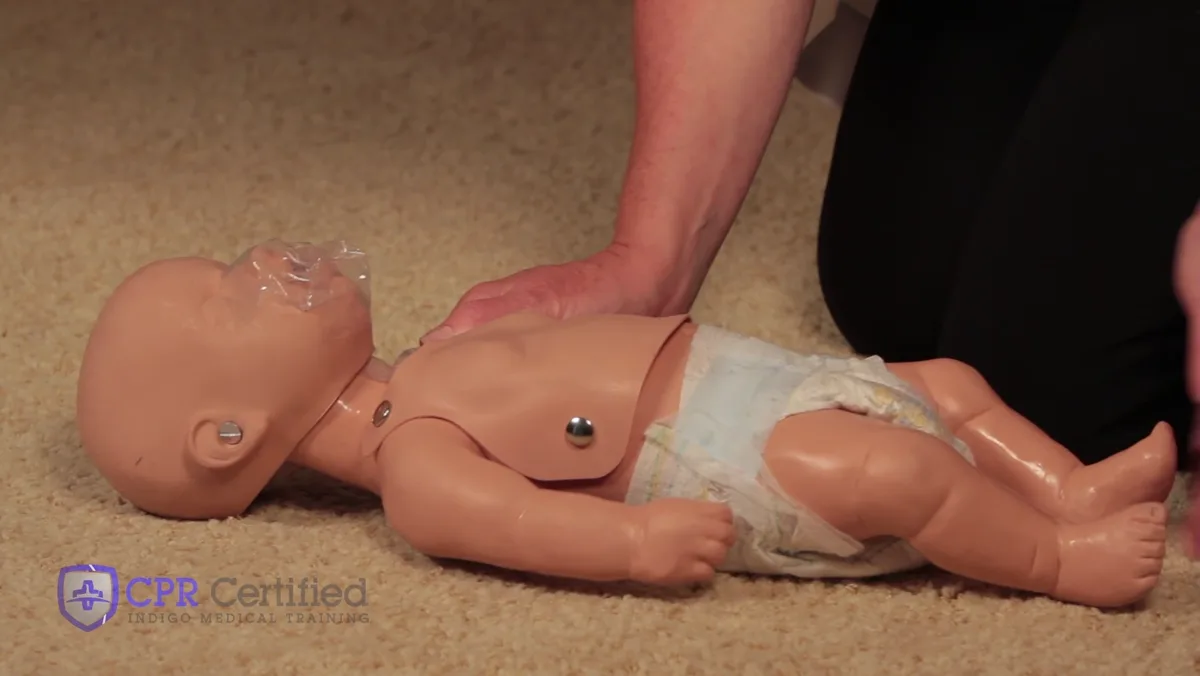
If there's no response, look at the chest for five to ten seconds. Gasping, gurgling or catching sounds are not breathing. You don't check for a pulse — not on the wrist, not on the arm, not anywhere. Finding one on a baby is hard even for people who do it daily, and the time it costs is the time compressions should be happening. The whole recognition test is two things, and that's deliberate.
The technique that changed
Here's the part to read twice, because it's the thing most likely to be out of date in your memory.
The two-thumb grip is the one to learn. Your hands encircle the chest, thumbs together in the middle, and you squeeze as much as you press — it turns out to give better depth and better blood flow than anything else. If your hands are too small to wrap around the baby, or you can't get into position, the heel of one hand works.
If you were taught to use two fingers, that's the part that changed. It was the standard for years, and it was replaced because it tends to press too shallowly to move enough blood. What changed and when covers this and the rest of the 2025 updates.
How deep on a body that small
About an inch and a half, or roughly a third of the way through the chest. That's deeper than almost anyone expects, and pushing too gently is by far the more common mistake.
It will feel like too much. That feeling is the thing to push through — a baby whose heart isn't moving blood needs the depth more than they need you to be gentle, and compressions that don't reach are compressions that don't work. Let the chest come all the way back up between each one.
Breaths for lungs that hold almost nothing
Tilt the head back only slightly — a baby's airway closes if you tip it too far, which is the opposite of what people expect. Then cover both the nose and the mouth with your mouth and give two breaths, about a second each.
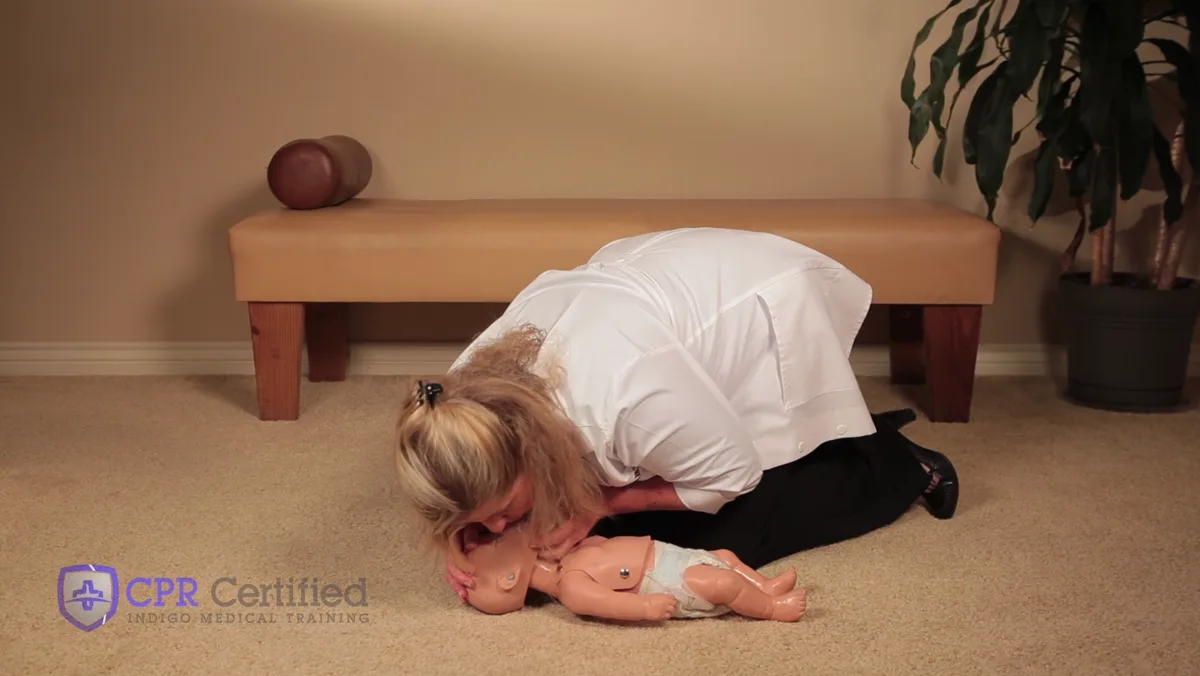
Use puffs, not breaths. The amount of air in your cheeks is closer to right than the amount in your lungs — a baby's lungs are tiny, and too much force does its own damage. You're watching for the chest to rise a little, and that's all you need to see.
Then thirty compressions, two puffs, and keep going.
Alone with the baby
With a phone: call 911, speaker on, put it down beside you, and start. You do both at once, and the dispatcher will help.
Completely alone with no phone in reach: give about two minutes of CPR first, then go and call. Babies almost always stop breathing before their heart stops, so those first two minutes of air and circulation are usually the thing that helps most. Carry the baby with you if you can and keep going when you get there.
This is the same rule as CPR on a child, and a different one from CPR on an adult, for that reason.
This is not the same as choking
Worth separating clearly, because the two get confused and the answers are different. A choking baby is conscious and struggling to breathe — that's back blows and chest thrusts, and it has its own lesson.
What's on this page is for a baby who is unresponsive and not breathing normally. If a choking baby goes limp, you move from that lesson to this one.
Put it into practice
Training scenario:
It's a Tuesday evening and nothing is wrong. You're looking after your sister's four-month-old for the first time, she's asleep upstairs, and you've just read this page because the thought crossed your mind. You've got no training. Your sister is at dinner twenty minutes away, your phone is on the arm of the sofa, and you're trying to work out whether you'd actually be able to do any of this.
Walking it through:
The first sixty seconds are shorter than you think. Tap her foot and call out. Look at the chest for five to ten seconds. If she doesn't respond and isn't breathing normally, that's the whole test — you have what you need and there's nothing else to check.
Your phone is on the sofa, which means the call and the compressions happen together: 911, speaker, put it down. You never face the two-minutes-then-call version, and that's worth noticing — the phone in the room is the single thing that most changes how this goes.
The instinct that would be wrong is gentleness. An inch and a half on a four-month-old feels like far too much, and it is the right amount — the mistake almost everybody makes is pressing too softly. The other one is looking for a pulse, because it feels like the responsible thing to do. It isn't. You already know enough to start, and starting is the part that matters.
Medically reviewed by Dr. Mary Williams, RN, DC
Video transcript
0:00 in this video I'm going to demonstrate how to perform CPR on an infant if the victim is an infant we do many of the
0:07 same steps we just learned for adult and child CPR the CPR cycle is the same for everyone 30 compressions to two breaths
0:17 when you check to see if an infant is okay tap the infant's foot baby baby are you okay shout for help help somebody
0:27 help call 911 scan the head and chest for signs of not breathing or just gasping sounds remember gasping is not breathing check
0:40 for a brachial pulse with an infant we use only two fingers to do compressions compressions for infants are approximately 1 and 1/2 or 4 cm deep
0:55 use the same forehead tilt and Chin lift to open the airway [Music] breaths are small Puffs and The Rescuer mouth will cover both the nose and mouth
1:19 of the victim small Puffs are important for an infant because its lungs are small we don't want to damage their
1:27 lungs with too much force observe for signs of chest rise between breaths and reposition if needed again the CPR cycle is the same
1:40 for everyone 30 compressions to two breaths most importantly compressions are deep and fast at least 100 compressions per minute
A one-page version of this lesson, made for printing. Everything above is the current sequence.
 Download or print this sheet
Check yourself
Three questions on what you just read.