

In this video, we teach you how to use an ambu bag, including how to get a mask seal that actually works.
What you’ll learn
- Seat and hold a mask so air actually goes in
- Work the bag alone, or split the job with a second rescuer
- Give breaths at the right size and speed
- Pick the right size of bag for the person in front of you
- Know when to put it down and go back to compressions
If there's one of these in a bag at your work, you probably inherited it. Somebody bought it, somebody put it in the kit, and it's been sitting there ever since with nobody entirely sure who's meant to know how it works.
It's a simple device with one difficult part, and almost everything that goes wrong with it goes wrong in the same place.
What you’re holding
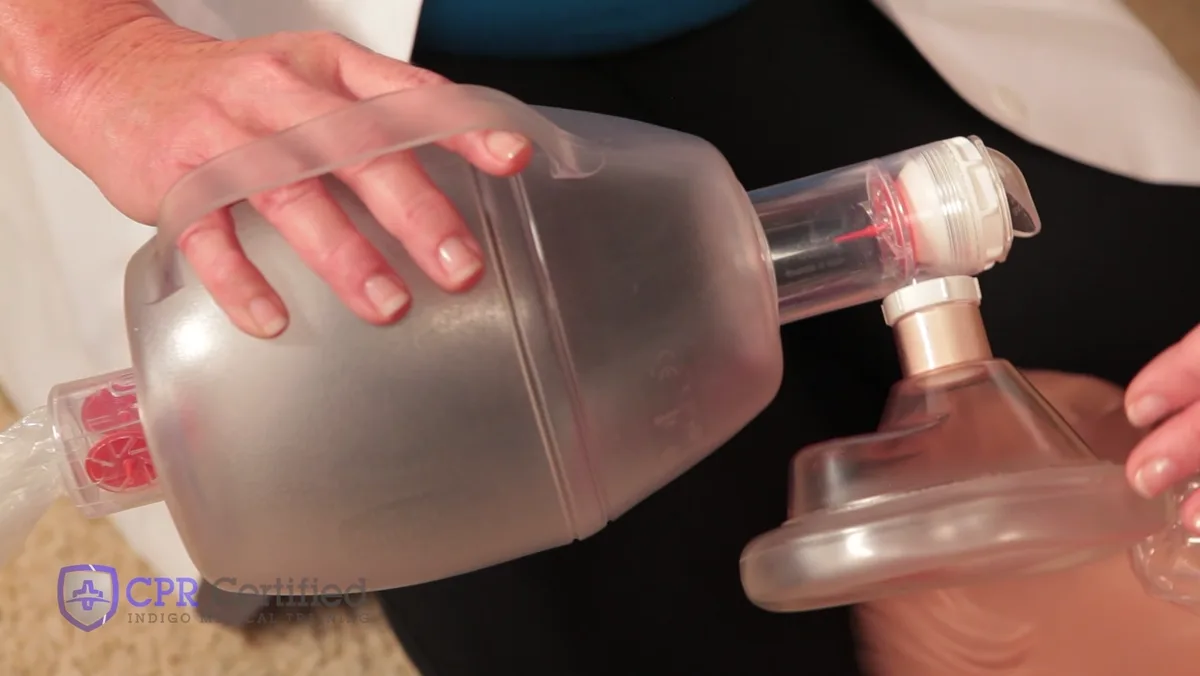
A soft bag, a one-way valve, and a mask. You squeeze the bag, air goes through the valve and into the person; they breathe out through the valve rather than back into the bag. It means you can give rescue breaths without putting your mouth on a stranger, which is the reason most people are glad it's there.
It doesn't replace anything else. It sits inside CPR where the breaths go, and the compressions are still doing the heavy work.
The seal is the whole skill
Here's the difficult part, and it's worth more attention than the rest of the page combined. If air escapes around the edge of the mask, none of it reaches the lungs — and the bag will still squeeze happily, so nothing tells you it isn't working except a chest that doesn't move.
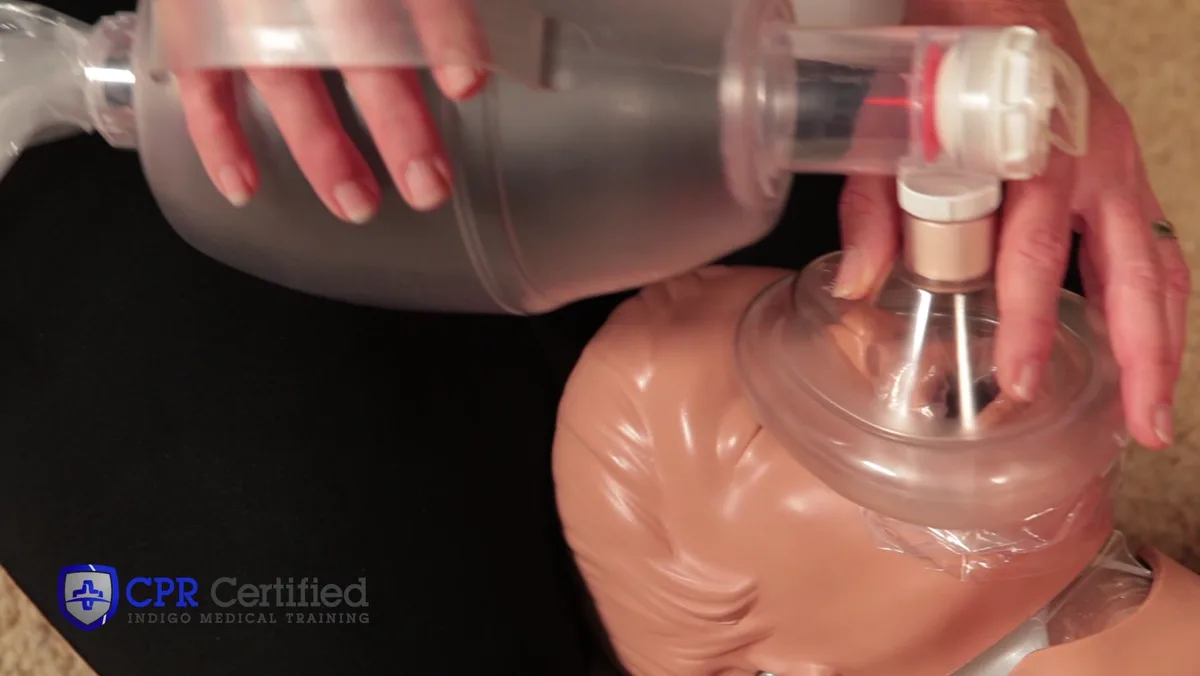
Get the mask the right way around. The narrow, pointed end goes over the bridge of the nose. The wide, rounded end sits on the chin. Backward, it can't seal at all.
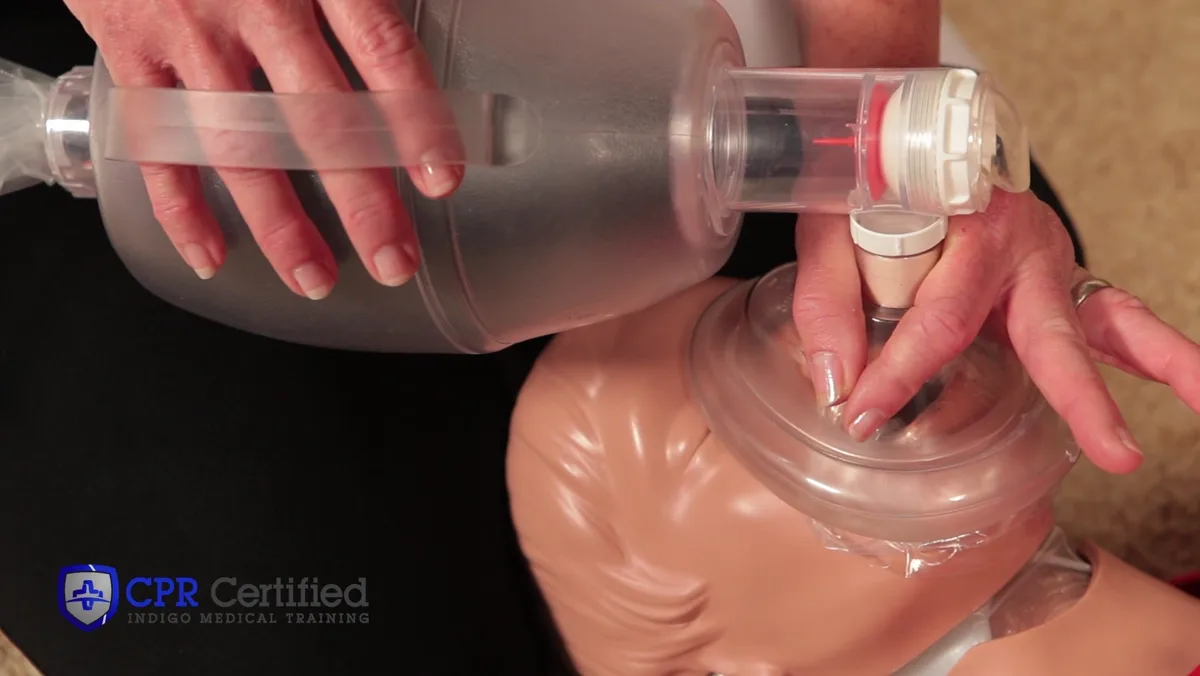
Thumb and index finger on the mask, making a C shape around the stem where the bag attaches. That hand holds the mask down.
Your other three fingers go under the jawbone — not on the soft part under the chin, on the bone itself — and pull upward.
That upward pull is the thing to understand: you're lifting the face into the mask, not pressing the mask onto the face. Pressing down closes the airway and breaks the seal at the same time, which is why squeezing the bag harder never rescues a bad seal. When it isn't working, the fix is always the jaw, never the squeeze.
On your own versus with a partner
Alone, you have one hand on the mask and one on the bag, which is the harder version. Kneel behind the person's head and steady their head between your knees — it sounds odd and it works, because it stops the head rolling every time you squeeze.
With two people it gets much easier: one person uses both hands on the mask, thumbs and index fingers making C shapes on each side and the remaining fingers lifting the jaw, while the other squeezes the bag. If a second pair of hands turns up, the mask is the job to keep — it's the one that needs the skill.
How hard and how often to squeeze
You're watching the chest, not the bag. A chest that rises means the seal is good and the volume is right; a chest that doesn't means the jaw needs lifting or the mask needs reseating. Squeezing faster or harder pushes air into the stomach instead, which makes vomiting more likely and helps nobody.
Sizes, and why the wrong one fails
These come in adult, child and infant sizes, and the two ends fail differently. A mask too big for a small face can't seal around it, so nothing goes in. A bag too big for small lungs delivers more volume than they should take, which can do damage of its own.
Match the size to the person if you can. Child CPR and infant CPR both cover what changes about the breaths themselves.
Knowing when to stop trying
This is the part device instructions usually leave out. There’re situations where the right move is to stop trying to use it.
You can't get a seal after a couple of tries. Two failed attempts is enough — stop and go back to compressions.
You're on your own and struggling. One person doing bad breaths and interrupted compressions helps less than one person doing good compressions.
You've never handled one before and there's nobody to show you. Learning it on someone in cardiac arrest is not the moment.
In all three cases the answer’s the same: chest compressions, without stopping. The bag is worth having and worth learning. It isn’t worth the pause.
Put it into practice
Training scenario:
You're the designated first aid responder at a small manufacturing site. Someone in the warehouse has collapsed and a colleague is already doing compressions. You arrive with the site's first aid bag, which contains an ambu bag you've seen in training photos and never held. There's one other person free and standing nearby, doing nothing in particular.
Walking it through:
Give the spare person a job first, and make it a specific one. The best use of them isn't the bag — it's taking over compressions in two minutes when your colleague starts to fade, and going out to bring the ambulance crew in. Naming the job out loud is what makes it happen.
Then the bag, and the honest version: you've never used one. That's a reason to try carefully, not a reason to refuse — the seal’s the only hard part and you know what it looks like. Narrow end on the nose, wide end on the chin, C shape with thumb and finger, three fingers pulling the jaw up into the mask.
What tells you within ten seconds is the chest. If it rises when you squeeze, you have it. If it doesn't, lift the jaw more and reseat the mask — and if the second attempt does nothing either, put the bag down and get back on the chest with your colleague. Nobody has ever died of a rescue breath they didn't get; plenty have died of compressions that stopped.
Medically reviewed by Dr. Mary Williams, RN, DC
Video transcript
0:00 in this video I'm going to demonstrate how to perform CPR with an amboo bag an amboo bag is a device that assists in
0:09 performing rescue breathing during CPR if you do have access to an amboo bag you should use it when using an amboo bag for CPR it's easiest to
0:20 stabilize the victim's head between your knees while you administer it on an amboo bag there is a mouthpiece and a
0:28 balloon-shaped bag place the pointed end over the victim's nose and the rounded end over the chin hold the mouthpiece
0:36 stem with your thumb and First Finger hold the mask and the victim's chin with your other three fingers to perform breaths simply push
0:47 down on the bag part giving two breaths about 1 second each allow for chest rise two breaths should take no more than 5
0:57 Seconds there are adult child and infan size amboo bag sets if available use whatever is appropriate
Check yourself
Three questions on what you just read.