

In this video, we teach you how to use an AED, including where the pads go and whether it can shock someone by mistake.
What you’ll learn
- Open the case and turn it on without hesitating
- Place the pads correctly, including on a wet or hairy chest
- Keep everyone clear at the moment that matters
- Get back to compressions immediately after a shock
- Answer the three fears that stop people using one
You’ve almost certainly walked past one. A white or green box on a wall, in an office hallway or a gym or an airport, with a heart symbol on the front. Most people have never opened one and just assume it's for somebody more qualified.
It isn't. These machines were designed on the assumption that the person opening the box has never seen one before and is frightened — which is why almost everything about using one is the machine telling you what to do next.
Turn it on before anything else
If you remember one thing from this page, make it this one: press the power button first, then listen. From that moment the device talks. It'll tell you to attach the pads, tell you to stand back, tell you when it's analyzing, and tell you whether to press the button. You aren't expected to know the sequence — you're expected to follow it.
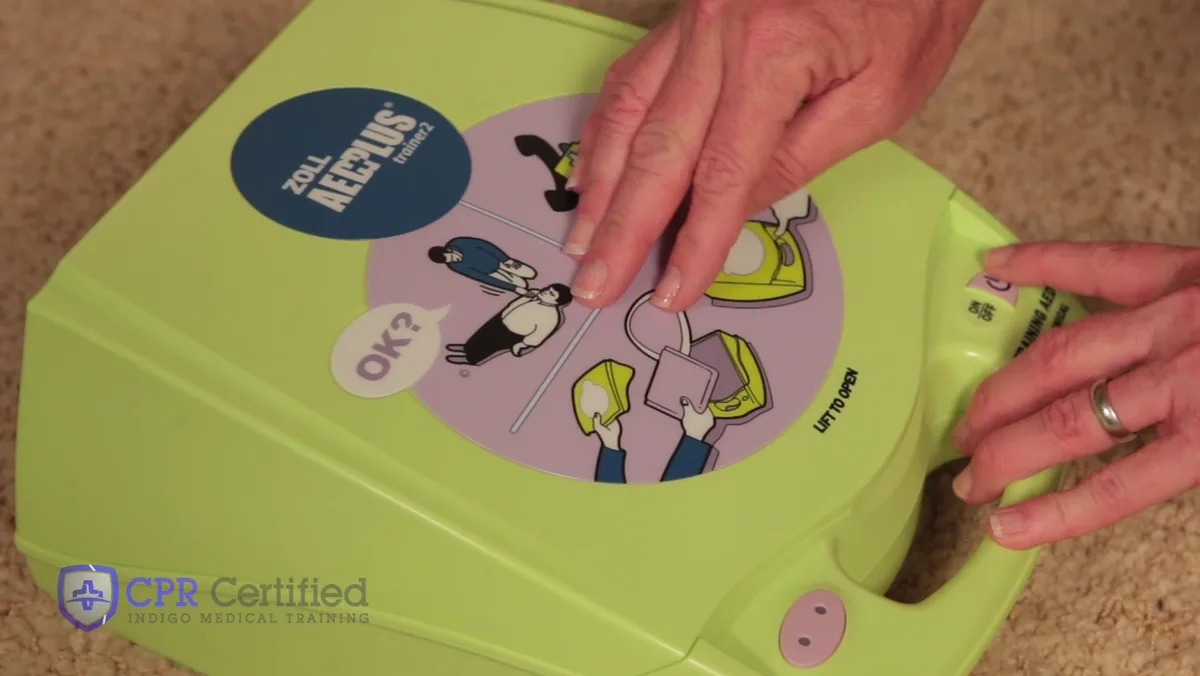
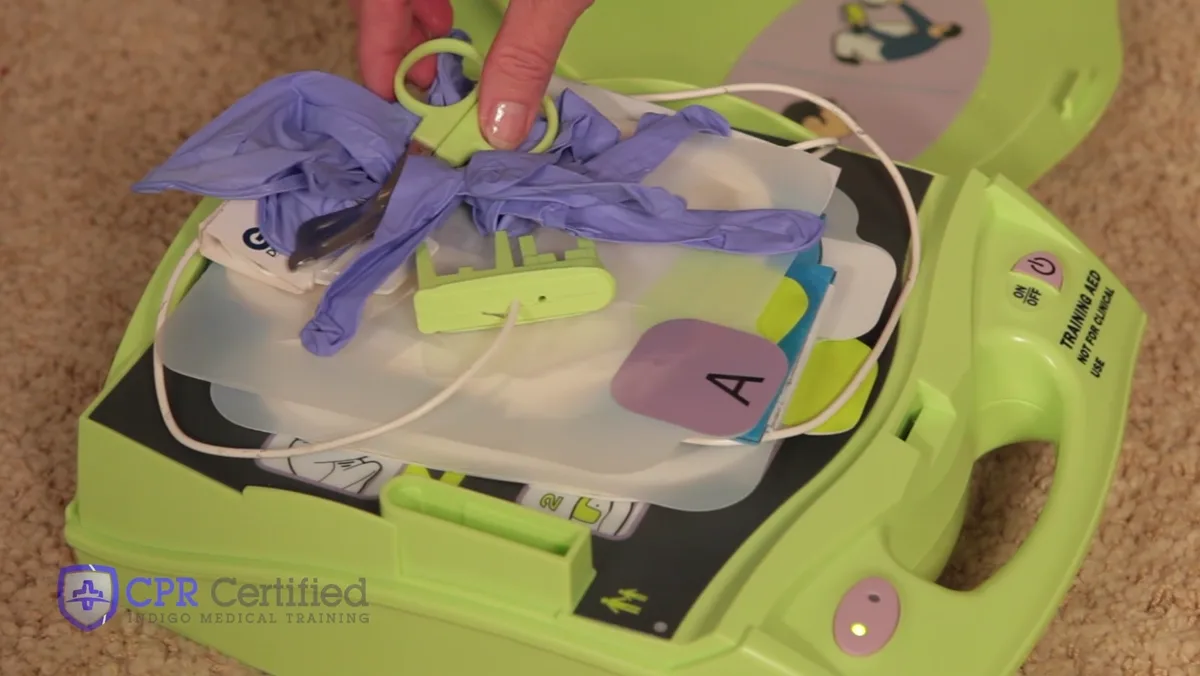
Everything else on this page is really just what those prompts mean and why they're in that order.
What the machine is actually doing
An AED — an automated external defibrillator — reads the electrical rhythm of the heart and decides whether a shock would help. Some rhythms respond to one; most don't, and shocking those would achieve nothing.
This is the part worth knowing before you're ever holding one: it won't shock somebody who shouldn't be shocked. If the rhythm isn't one a shock can fix, the machine says so and tells you to continue compressions instead. The decision isn't yours, which is exactly what makes the device usable by someone who has never touched it.
What it doesn't do is start a heart that has stopped entirely. That's why compressions keep going before and after — the shock is a reset, not an ignition, and the compressions are what keep blood moving in the meantime.
Time matters more here than almost anywhere else in first aid. Every minute without defibrillation lowers the odds sharply — which is why somebody is sent for the box the moment you realize what's happening, rather than after you have tried everything else.
Pads on a bare chest
The chest has to be bare, and the case is stocked for that.
Scissors are in the lid. Cut the shirt rather than wrestling it off. If there are no scissors, tear it or pull the buttons.
The pads have a picture on them. Place them exactly as shown — one upper right, one lower left — and press them down firmly so the whole surface is in contact.
A hairy chest gets the razor that's also in the case. Pads can't read through hair, and a quick pass over the two spots is enough.
A wet chest gets a towel. It doesn't need to be perfectly dry — just not running with water. Don’t spend time you haven’t got on this.
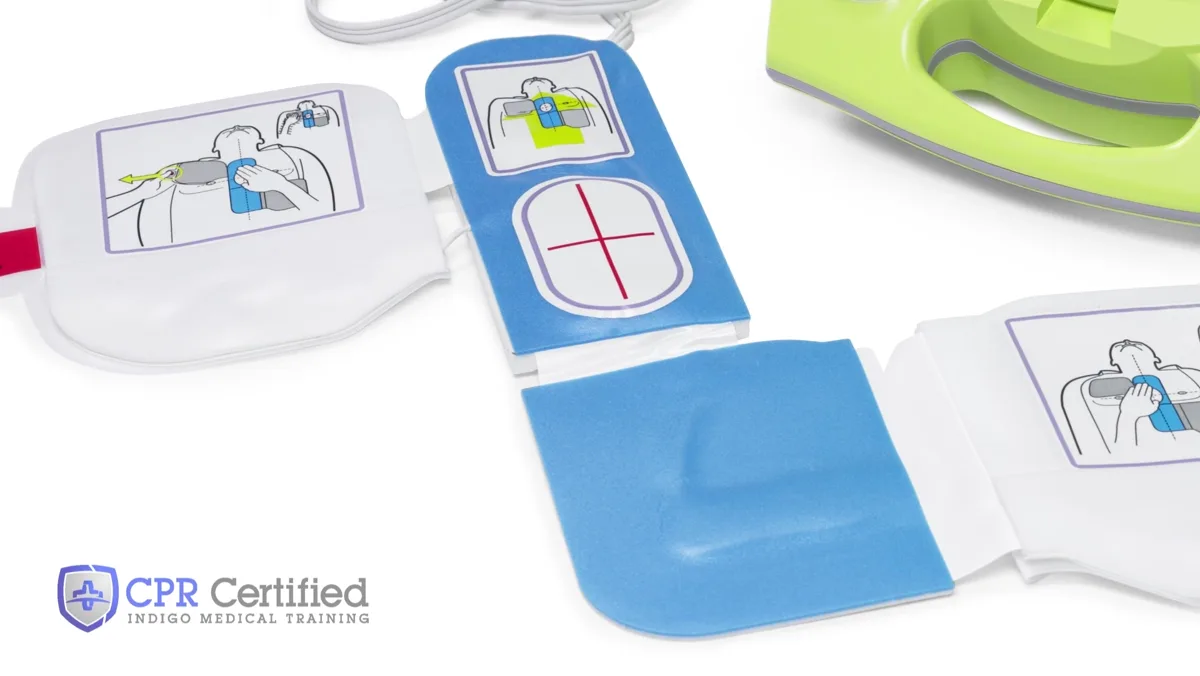
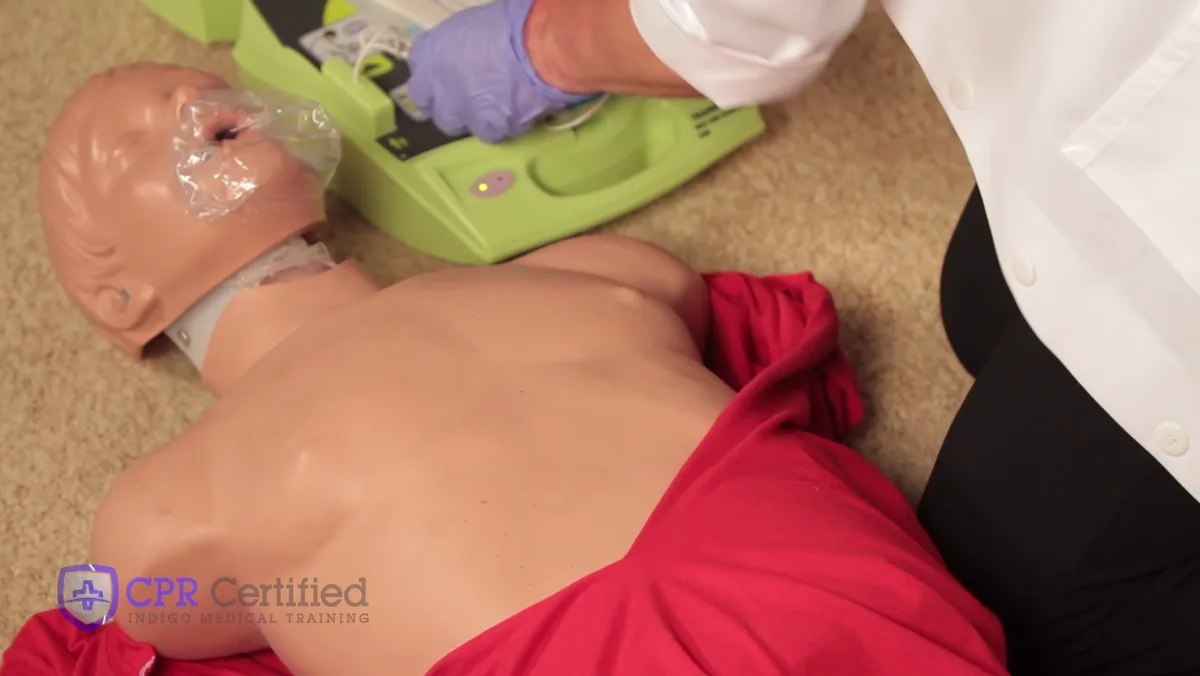
The same rule about bare skin and firm contact applies to a heavier chest: the pads need to sit flat against skin, and they must never touch each other. If someone else is there, they should keep doing compressions the entire time you're opening the case and placing the pads. The machine will tell you when to stop.
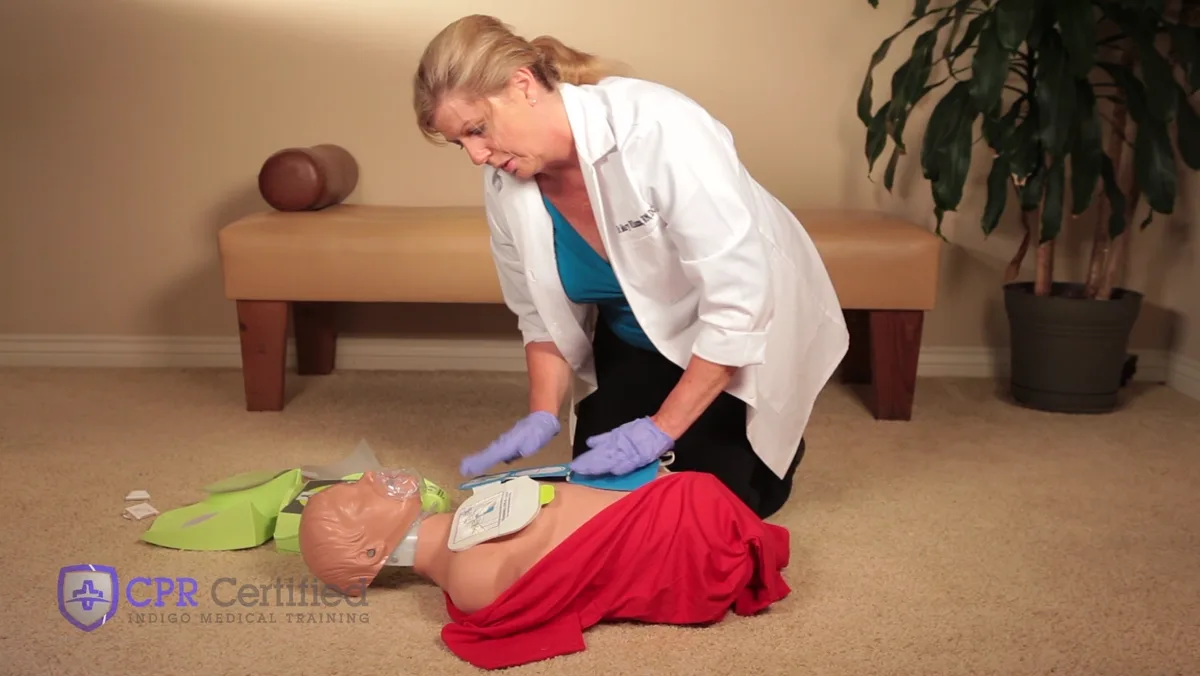
Stand clear, then straight back to compressions
When it says it's analyzing, nobody touches them — not their hand, not their leg, not the surface they're lying on. Say it out loud: "everybody clear." Then look, rather than assuming.
If it advises a shock, check once more that nobody is in contact, and press the flashing button.
Then go straight back to compressions. Do not wait to see what happens. This is the step people get wrong, because the instinct after a shock is to pause and watch for a result. There's nothing to watch — the device will re-check the rhythm on its own after about two minutes and tell you what it wants next. The gap in between belongs to compressions, and if you're on your own and not giving breaths, that's fine.
The three things people are afraid of
There's a fourth question people ask quietly, which is whether they could get in trouble for trying. Protections for people who help in an emergency exist in some form almost everywhere, and the details vary by state — so this page won't pretend to tell you what yours says. What it'll say is that the fear is common, it's understandable, and it isn't a reason to leave the box on the wall.
Put it into practice
Training scenario:
You work in an open-plan office. A colleague two desks over has collapsed and isn't responding or breathing normally. Someone is already doing compressions and someone else has called 911. There's an AED in a case by the elevators — you have walked past it every day for three years and never opened it. Somebody says "does anyone know how to use that thing?"
Walking it through:
You get it. That's the answer to the question in the room, and hesitating for someone more qualified is the failure mode this device was designed around — there's no more qualified person coming in the next four minutes.
The first thing after opening it's the power button. Not reading the pads, not working out the order, not asking anyone. Turn it on and it starts telling you what to do — and everything you were worried about forgetting is now something the machine says out loud.
Compressions carry on the whole time you're cutting the shirt and placing the pads. When it says to stand clear, say it out loud and check with your eyes. If it shocks, press the button and then get hands straight back on the chest without pausing to see what happened. And if the person turns out to be a child rather than an adult, there's one thing that changes — but the machine and the sequence stay the same.
Medically reviewed by Dr. Mary Williams, RN, DC
Video transcript
0:00 in this video I'm going to demonstrate how to use an automated external defibrillator in previous video clips you've heard me mention an AED or
0:11 automated external defibrillator now I'm going to show you how to use one these are wonderful machines which have made a huge
0:19 difference in the recovery of cardiac arrest victims don't be nervous it's really very easy to use research shows that more than 95% %
0:30 of cardiac arrest victims die before reaching the hospital a victim's chances of survival are reduced by 7 to 10% with
0:40 every minute that passes without CPR and defibrillation few attempts at resuscitation succeed after 10 minutes
0:49 nearly 60% of all cardiac arrests are witnessed so if an AED is nearby there's a better chance for survival if timely
0:58 defibrillation occurs in cities where defibrillation is provided within 5 to 7 Minutes the survival rate from Sudden Cardiac Arrest
1:08 is as high as 30 to 45% other examples show survival rates as high as 86% in some cases step one turn the AED on next take
1:23 the lid off pads scissors eraser and gloves will be tucked inside the lid the AED will then audibly prompt The Rescuer
1:33 stay calm check responsiveness call for help attach def pads to patient for chest don't touch patient analyze it
1:45 shock advised press flashing shock button shock delivered start CPR so just listen and follow directions the path ads have a diagram
2:00 on them indicating where to place them but before you can do that you will notice that scissors are provided to cut
2:07 the victim's shirt off if your AED doesn't have scissors tear the buttons off the shirt if the victim has a hairy chest
2:18 use the razor supplied with your AED to shave the area where the patch is to be applied and if the victim is wet use
2:27 clothing or a towel to dry his or her chest it's not necessary to be totally dry though if the AED advises you that shock
2:53 is advised it's important not to touch the victim during the shock it will allow LLY say shock advised don't touch patient press
3:04 flashing shock button then push the red heart or electric bolt button once the AED will prompt you by saying Rhythm
3:14 restored or shock delivered start [Music] CPR [Music] [Music] after every five Cycles or about every 2 minutes allow the AED to analyze the
3:49 Rhythm and continue CPR until the emergency medical team arrives
Check yourself
Three questions on what you just read.