

In this video, we teach you hands-only CPR — chest compressions given without rescue breaths.
What you’ll learn
- Decide quickly whether compressions alone are the right call
- Recognize the situations that still need rescue breaths
- Push at the right depth and speed without stopping
- Understand why compressions alone work at all, and for how long
- Keep going, and know when to hand over
There's a version of CPR with no mouth-to-mouth in it, and it isn't a shortcut or a watered-down alternative. For an adult who collapses suddenly in front of you, pushing on the chest and never stopping is what the guidelines actually recommend if you haven't been trained — or if you have been, and you're not going to put your mouth on a stranger.
Which is worth saying plainly, because the hesitation is the dangerous part. People who aren't sure they're allowed to do the simple version often end up doing nothing at all.
Compressions only, and nothing else
That's the whole method. You find the spot, you push hard and fast, and you don't stop until somebody takes over or the person starts moving. No breaths, no counting to thirty, no cycles — just continuous compressions.
Everything before that’s the same as any other CPR: make sure the scene is safe, tap and shout, and if they don't respond and aren't breathing normally, that's all the checking you need to do. Call 911 first, speaker on, and get someone to find a defibrillator if there's one nearby.
The person this is written for
That last one matters more than it looks. A sudden collapse in an adult usually means the heart stopped first — and for the first several minutes, their blood still has oxygen in it. Your job is to keep that blood moving to the brain. You aren't replacing their breathing; you're buying time with what's already there.
The emergencies that still need breaths
This is the part a page like this has to be honest about, because compressions alone are genuinely not enough for everyone.
Children and babies. They almost always stop breathing before their heart stops, so there's less oxygen left in the blood to circulate. CPR on a child and on an infant both include breaths for that reason.
Drowning. Same logic — the problem started with air, so air is part of the answer.
An overdose, or anything else where breathing stopped first.
A collapse nobody saw, where the person may have been down long enough for the oxygen to be gone.
If you can give breaths in those situations, give them. If you genuinely can't, compressions are still far better than standing there — the point isn't that hands-only fails, it's that it was designed for a different problem.
Push here, this hard, this fast
Arms straight, shoulders directly over your hands, and push with your body weight rather than your arms. Counting out loud helps, and so does humming something at about the right tempo.
It's tiring in a way people don't expect — most rescuers get noticeably shallower after a couple of minutes without feeling any different. If there's someone else there, swap every two minutes. If a defibrillator arrives, use it; it will tell you when to start pushing again.
Why it works, and for how long
The short answer is that a chest compression is a pump. Pressing down squeezes the heart between the breastbone and the spine and pushes blood out; letting the chest rise lets it refill. That's why coming all the way back up matters as much as pressing down, and why stopping is expensive — it takes several compressions to build the pressure back up each time you pause.
The oxygen already in the blood is enough to make that worth doing for the first several minutes, which is roughly the window before help arrives. Past that, breaths start to matter more — which is one more reason the call goes out first and why the full sequence exists for anyone willing to learn it.
Put it into practice
Training scenario:
You're at home on a Sunday afternoon. Your husband stands up from the sofa, says something odd, and goes down hard. He's not moving and he's making a sound you'd describe as snoring. You’ve never taken a first aid class in your life. Your phone is in your hand because you were already looking at it.
Walking it through:
The snoring is the most important detail, and it's the one that fools people. That sound is not breathing. It's common in the first minutes after a heart stops, and it’s the single most frequent reason someone waits instead of starting. He isn't responding and he isn't breathing normally, which is the whole test.
The phone in your hand is doing you a favor. Call 911, put it on speaker, drop it on the floor next to you, and start pushing. The dispatcher will coach you and will not mind that you've never done this — that call is exactly what it's for.
Then compressions, and only compressions. He's an adult, he collapsed in front of you, and you haven't been trained — that’s precisely the situation hands-only was written for. Heel of your hand on the middle of his chest, at least two inches, a hundred to a hundred and twenty a minute, and don't stop to check anything. You’ll get tired and it’ll feel like a long time. Keep going anyway.
Medically reviewed by Dr. Mary Williams, RN, DC
Video transcript
0:03 first assess the scene look around make sure the scene is safe you can't help anyone if you become a victim too if the
0:13 scene is safe check the person for a response tap or shake the victim on the shoulder and Shout are you okay if you
0:21 do not get a response from the victim yell for help next tell a specific bystander to phone 911 or the eer mergency response
0:30 number remove clothing out of the way of the victim's chest next locate your hand placement for compressions with your hand draw a line
0:41 from armpit to center of chest for placement place the heel of one hand on the lower half of the sternum or breast
0:51 bone now place your other hand over the first interlacing your fingers for support with your arms straight and your
1:00 shoulders positioned over the victim's chest push down on the victim's chest for an adult you will want to push down
1:08 at least 2 in or 5 cm now watch as I perform 30 deep compressions in 18 seconds or less you want to be able to give at least 100
1:19 compressions in a minute you may lift your hands slightly off the chest between compressions to allow for full
1:27 chest recoil but keep your hand placement keep interruptions to a minimum it helps to count out loud some say humming the tune to the 1980s pop
1:39 tune Staying Alive is good for keeping the right tempo
A one-page version of this lesson, made for printing. Everything above is the current sequence.
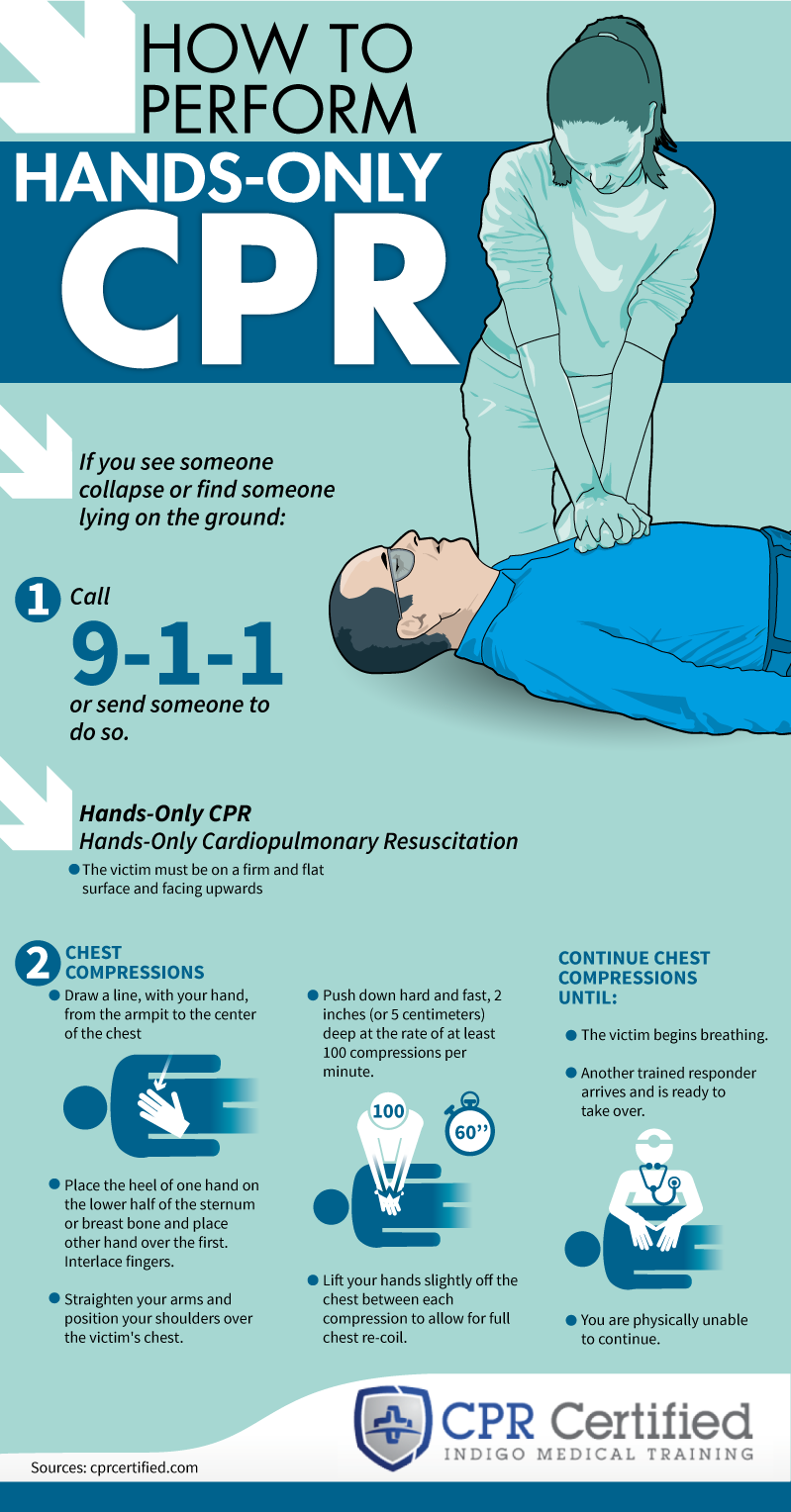 Download or print this sheet
Check yourself
Three questions on what you just read.