

In this video, we demonstrate the choking rescue for a baby, including back slaps and chest thrusts, and how to hold an infant safely while you do it.
What you’ll learn
- Recognize choking in a baby who can give no signal — and distinguish it from other causes of limpness
- Perform the back-slap and chest-thrust cycle, and explain why abdominal thrusts are never used on infants
- Identify the moment the choking response becomes infant CPR
- Apply the prevention habits that cover most infant choking risks
A choking baby is every parent’s nightmare scenario, and it comes with a cruel twist: an infant can’t tell you. No universal choking sign, no pointing at the throat — a choking baby simply goes quiet, straining to cough or cry with little or no sound coming out. Recognition is the skill, because the silence that should be a scream is the whole alarm.
The response is different from the adult technique in one absolute way — abdominal thrusts are never used on a baby — and the technique that replaces them is gentle in setup and firm in execution: gravity, back blows, and chest thrusts, cycling until the airway clears. This lesson walks the full sequence, the transition to infant CPR, and the prevention habits that keep most families from ever needing page one. For anyone age one and older, use How to Save a Choking Adult or Child instead.
Recognizing it: the quiet emergency
A choking infant will look like they’re trying — to cough, to cry — with little or no sound. You may see wide eyes, a reddening then bluish face, ribs pulling in with effort. If the baby is coughing audibly or crying loudly, air is moving: stay close, stay calm, and let the cough work. The silent strain is your signal to act.
Not every limp baby is choking. Choking looks like conscious effort — straining, mouth working, silence where sound should be. A baby found unresponsive without that struggle is a different emergency with its own causes — illness, injury, or overheating (an overdressed baby in a warm room or car can overheat into lethargy and unresponsiveness: flushed, hot skin is the tell). For any unresponsive infant: shout for help, get 911 dialing, check breathing, and start infant CPR if they aren’t breathing normally — and if overheating is the picture, get layers off and cool the baby while help comes. Don’t run the choking cycle on a baby who was never choking; respond to what you actually see.
How to Save a Choking Infant: Step-by-Step
Confirm it: straining to cough or cry with little/no sound = act now. Shout for help; if someone’s there, they call 911. Alone, put your phone on speaker with 911 as you work — the technique needs both hands, not your ear.
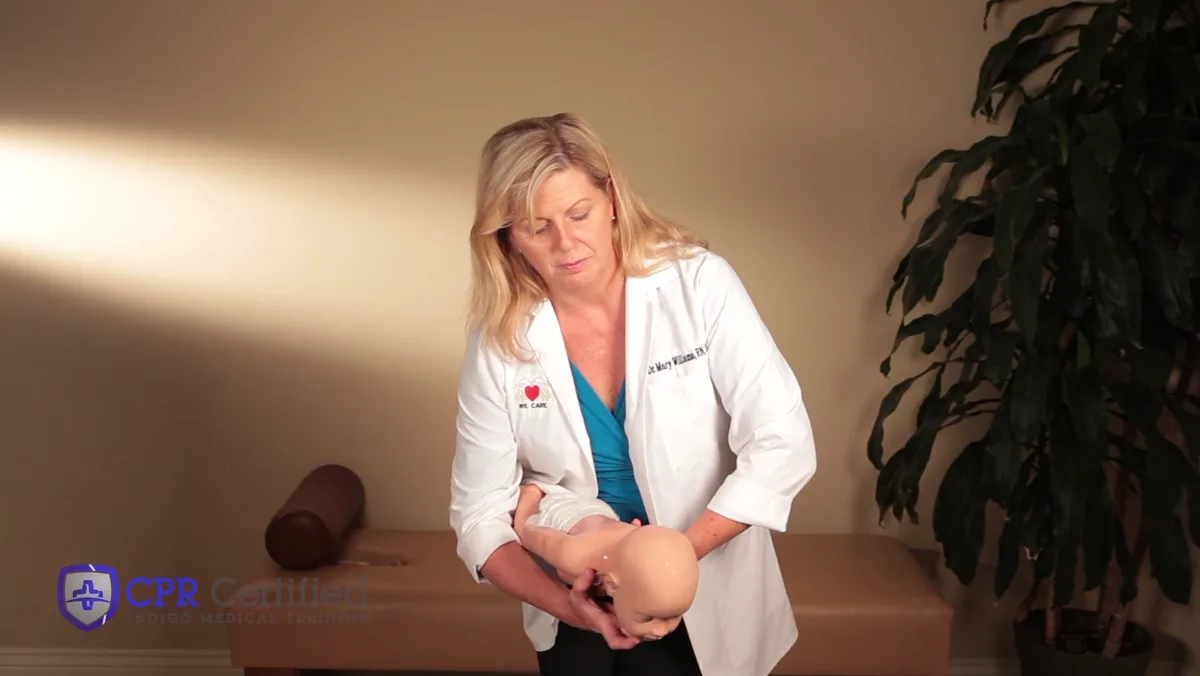
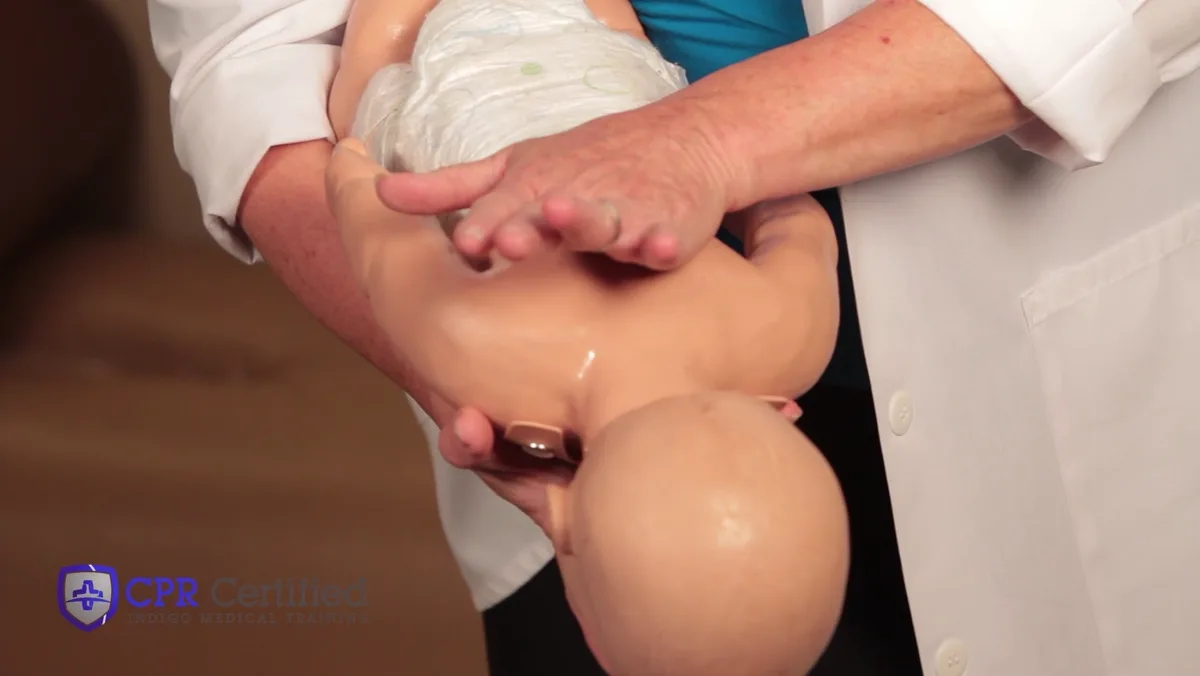
Position face-down on your forearm. Lay the baby along your forearm, face down, head lower than the chest, supporting the jaw and chest in your open hand — never squeezing the throat. Brace your forearm on your thigh.
Give 5 back slaps with the heel of your free hand, firmly, between the shoulder blades. Each slap is a separate attempt to knock the object loose.
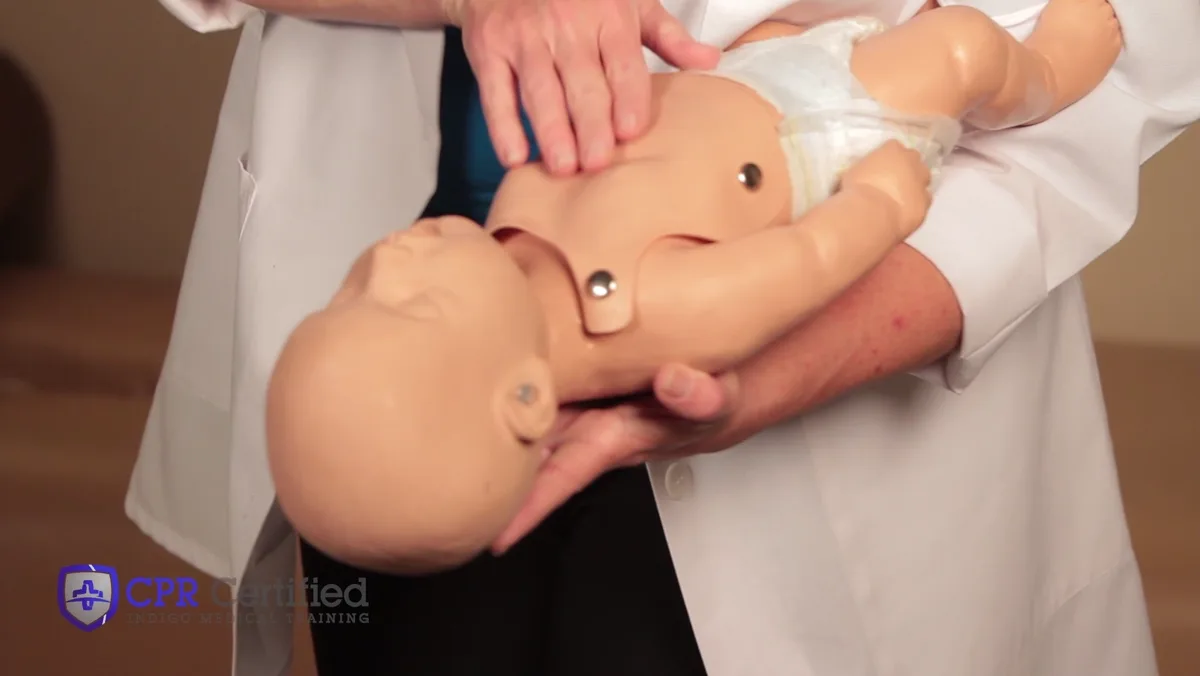
Flip and give 5 chest thrusts. Turn the baby face-up along your other forearm, head still lower than the body. Place the heel of one hand on the center of the chest, just below the nipple line, and give 5 quick downward thrusts — the same landmark as infant CPR compressions. (The 2025 guidelines moved this from two fingers to the heel of the hand, which reaches the depth the thrust needs.)
Repeat the cycle — 5 back slaps, 5 chest thrusts — until you hear the object come free, the baby cries, coughs, or breathes, or the baby stops responding. A crying baby is the best sound in the world right then: crying means air.
If the baby stops responding: infant CPR, immediately. On a firm surface: 30 chest compressions — two thumbs encircling the chest, or the heel of one hand on the breastbone if you cannot encircle it — then 2 gentle breaths covering the baby’s mouth AND nose with your mouth. Look in the mouth before breaths — remove the object only if you see it. Continue 30-and-2 until EMS arrives; the compressions themselves can push the object out.
Afterward: any infant who needed this sequence gets medical evaluation — same day, every time, even if the recovery looks complete.
What people get wrong
Prevention: the short list that covers most of it
Most infant choking involves a predictable cast: grapes, hot dogs, nuts, popcorn, hard candy, chunks of raw apple or carrot — and off the plate, coins, button batteries, magnets, balloon fragments, and small toy parts. The habits that neutralize them:
Cut round foods lengthwise — grapes and hot dogs into strips, never coins.
Nothing hard, small, and round for the youngest eaters; seated eating, always supervised.
Apply the small-parts rule: anything that fits through a toilet-paper tube can block an infant airway.
Button batteries are their own emergency — a swallowed battery burns tissue fast; it’s an immediate ER trip whether or not the baby seems fine.
Put it into practice
Training scenario:
Your 9-month-old is in the high chair while you clear dishes. You realize the room has gone quiet — she’s straining forward, mouth working, eyes wide, making almost no sound. A piece of her older brother’s snack is missing from the tray. Your partner reaches to pull it out with a finger; you can’t see anything in her mouth.
Walking it through: silence plus strain is infant choking confirmed — and the reaching finger is a blind sweep, which can push an unseen object deeper; it only comes into play if you can see the piece. Phone on speaker, 911 dialing. Baby face-down along your forearm, head below chest, jaw in your hand, forearm braced on your thigh: 5 firm back slaps between the shoulder blades. Flip her face-up: heel of one hand center-chest, 5 thrusts. Cycle. The moment she wails — that furious, beautiful cry — air is moving and the emergency is over; the pediatrician visit still happens today. Had she gone limp instead: firm surface, 30 compressions with two thumbs encircling her chest, 2 breaths over mouth-and-nose, and keep going until EMS takes over.
Medically reviewed by Dr. Mary Williams, RN, DC
Video transcript 1:44
0:00 In this video, I'm going to demonstrate how to save a choking infant whether conscious or unconscious. Choking can occur when food
0:09 or a foreign object blocks the airway. With an infant, it's up to an adult to remedy this. An infant cannot put their hands to their throat in the
0:19 universal choking sign. So if an infant is choking on something they will appear as though they are trying to cough or
0:27 cry with little or no sound. You must act quickly to remove the blockage. Do not stick your fingers in the infant's mouth unless you can easily
0:38 see the object causing the blockage because you might push the object in deeper. Instead, hold the infant face down
0:46 over your forearm. Hold the infant's chest and neck in your open hand. With your other hand, give five back slaps
0:53 with the heel of your hand. Hopefully this will dislodge the object. If not, turn the infant over face up over your
1:01 forearm, and with two fingers apply chest thrusts just like you would in CPR. Repeat the cycle of five back thrusts and five
1:09 chest thrusts until you hear the infant cry, breathe, or cough. If the infant stops responding, start CPR immediately. Yell
1:18 for help. Check for breathing. Give 30 chest compressions using two fingers over the breastbone. Give two breaths
1:27 covering the infant's mouth and nose continue these cycles of 30 compressions and two breaths until emergency response
1:36 personnel arrive. The chest compressions may push the object up and out of the airway.
Check yourself
Three questions on what you just read.