

In this video, we teach you how to perform CPR on a child, including how hard to push on a child's chest.
What you’ll learn
- Know which ages this applies to, and where the boundaries sit
- Understand why a child's emergency usually starts differently than an adult's
- Adjust hands, depth and ratio without relearning the whole sequence
- Handle the call correctly when you are alone with a child
- Recognize when a second rescuer changes what you do
If you've already read the adult page, most of this will look familiar, and that's the honest headline: you aren't learning a different skill. You're learning three adjustments and one reason they exist.
The reason is worth having first, because it makes the adjustments stick instead of turning them into a list you'll forget under pressure.
Mostly the same as an adult
The sequence doesn't change. Check the scene, tap and shout, look for normal breathing, get help moving, and start pushing on the chest. You don't need to check for a pulse unless you're a trained medical professional. The full adult sequence is the one to read if you haven't, and everything below assumes it.
A child, for this purpose, is anyone from about one year old up to puberty. Under one is an infant, and the technique changes again. Once a child looks like a young adult, treat them as one — nobody is checking a birth certificate, and the boundary is about body size rather than a birthday.
Why children collapse for different reasons
This is the part that explains everything else. An adult in cardiac arrest has usually had a heart problem — the heart stops first, and the breathing stops because of it. With children it's usually the other way around. Something interferes with breathing — an airway blockage, an asthma attack, drowning, an injury — and the heart stops afterward, because it ran out of oxygen.
That single difference is why breaths matter more for a child than for an adult, why the two-rescuer ratio gives more breaths rather than more compressions, and why the advice about when to call is different. It also means an airway blockage is always worth considering, because small children put things in their mouths and often nobody saw it happen.
Hands, depth and how many
One hand or two — your choice. Use whatever lets you push deep enough without tiring out. A larger child may need both; a small five-year-old usually doesn't.
About 2 inches deep, or roughly a third of the way through the chest. The fraction is the more useful version, because a child of six and a child of eleven are very different sizes.
Same spot, same speed. Lower half of the breastbone, 100 to 120 pushes a minute, and let the chest come all the way back up each time.
30 compressions, then 2 breaths, when you're on your own.
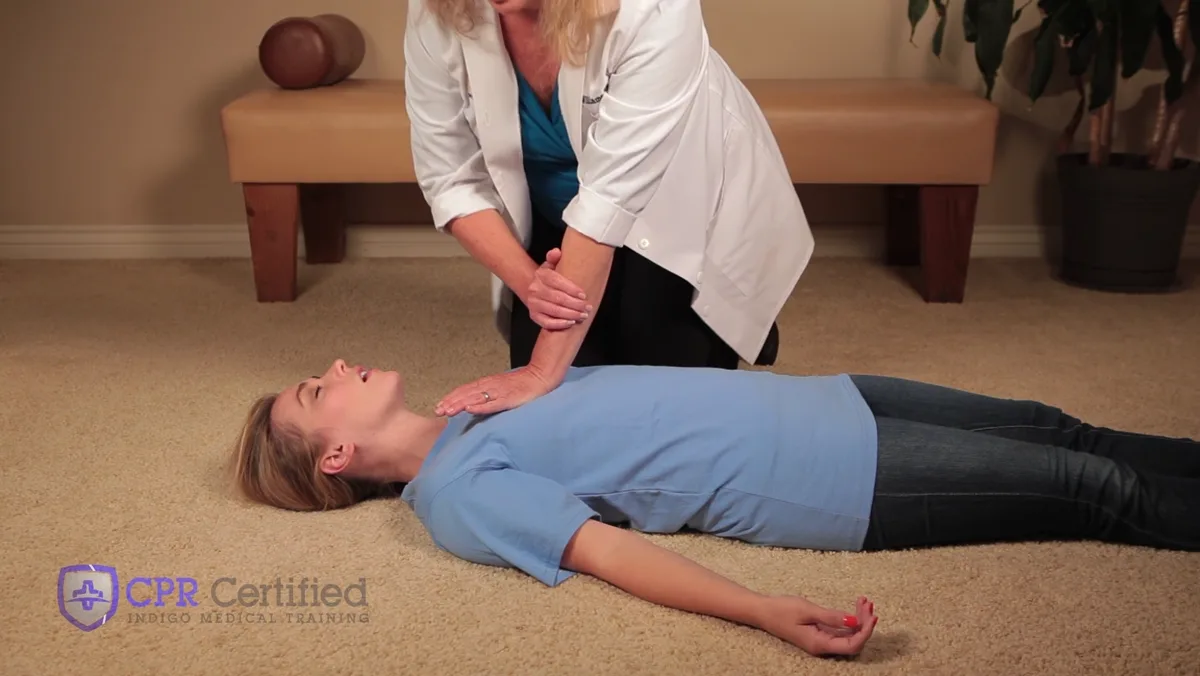
People push too softly on children far more often than they push too hard, and the reason is understandable — the body is small and the force feels wrong. Recognizing that it's time to start at all is the other half of that hesitation.
Calling for help when it’s a child
If you've got a phone, this is simple and it matches everything else: call 911, put it on speaker, set it down, and start CPR. You do both at once.
If you're completely alone with no phone within reach, the advice for a child is different from the advice for an adult. Give about two minutes of CPR first, then go and call. That's deliberate rather than an oversight — because a child's emergency usually starts with breathing, those first two minutes of oxygen are often the thing that actually helps, where an adult in the same position needs a defibrillator as fast as possible.
Take the child with you if you can carry them and keep going when you get there.
When a second rescuer arrives
This is the change most people have never heard, and it only applies once someone trained is helping you.
Fifteen and two, rather than thirty and two. More breaths, more often — which follows directly from why children arrest in the first place. One person does compressions, the other does breaths, and you swap every couple of minutes because good compressions get shallow faster than anyone expects.
If a defibrillator turns up, use it — there are a couple of things that change for a child, and they take about a minute to learn.
Put it into practice
Training scenario:
You're a summer camp counselor at a pool. A nine-year-old is pulled out of the shallow end by two other kids who thought he was messing around. He's not moving. The lifeguard is at the far end dealing with something else, there are maybe thirty children watching, and the nearest adult is a parent who has already started shouting. Your phone is in your bag, twenty feet away.
Walking it through:
The water tells you this almost certainly started as a breathing problem, which is the case for most children anyway. It doesn't change the sequence, but it does mean breaths are worth giving here if you're able — this is not a hands-only situation.
The phone solves itself, and it's the easiest part: you've got thirty witnesses and a shouting adult. Point at the parent, describe them, and give them the job — go get the phone from that bag, call 911, put it on speaker, bring it here. You never have to leave the child, so the two-minutes-then-call rule never comes up. That rule is for the version of this where you're genuinely alone.
Then: tap and shout, look for normal breathing for five to ten seconds, and start. One hand or two, about a third of the way into his chest, a hundred to a hundred and twenty a minute. When the lifeguard reaches you, switch to fifteen and two and let them take the breaths. And keep the other children back — not for their sake as much as for yours, because you need the room.
Medically reviewed by Dr. Mary Williams, RN, DC
Video transcript
0:00 in this video i'm going to demonstrate how to administer cpr on a child performing cpr on a child has a few minor but important differences
0:11 from administering cpr on an adult a child is anyone over the age of one year up to the time of puberty it's important
0:20 to note that children rarely have primary cardiac events they are much more likely to have respiratory incidents
0:28 children often place small objects in their mouths so always consider that an airway obstruction may occur if you did not see the child collapse
0:38 start cpr immediately give five cycles then call and get help our cpr compression breath ratio for children is the same as for adults thirty to two
0:52 for a child you may use either one or two hands for compressions push down two inches or five centimeters again cpr on a child is similar to adult
1:03 cpr with some exceptions you'd use the same compression ratio 30 to two unless a second rescuer is available then you would do 15 to 2. with a second
1:17 rescuer we recommend the 15 to 2 ratio for children it's just more effective if a pulse is present but slow such as less than 60 beats per
1:27 minute add compressions to enhance perfusion most of the time mouth guards are not used on children because you have to cover their nose and
1:37 their mouth
A one-page version of this lesson, made for printing. Everything above is the current sequence.
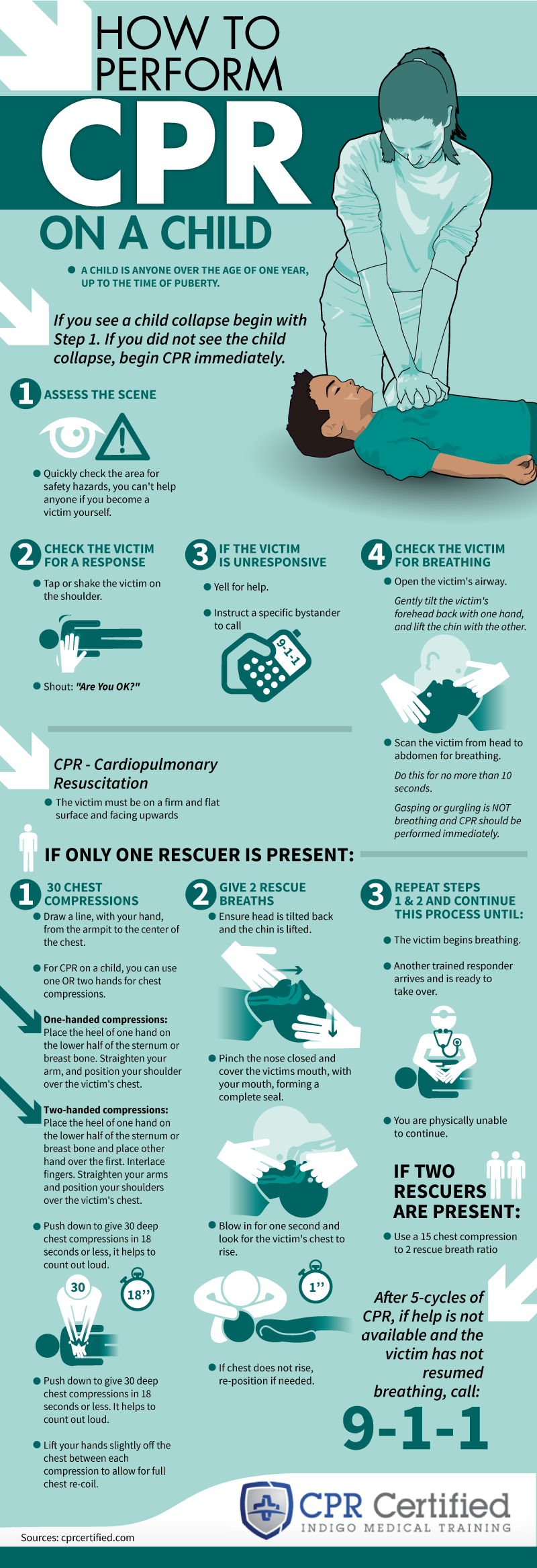 Download or print this sheet
Check yourself
Three questions on what you just read.