

In this video, we teach you how to perform CPR on an adult, including hand placement, how hard and fast to push, and rescue breaths.
What you’ll learn
- Know the two signs that mean you should start CPR
- How to get help for a victim in the most effective way
- Place your hands correctly and push to the right depth and speed
- Give breaths that go in — or decide not to give them at all
- Know when to stop, and what the AED changes when it arrives
Almost everyone who has watched someone collapse says the same thing afterward. Not that they didn't know what to do — that they stood there for a few seconds first, waiting to be sure. Waiting for the person to move, or for somebody else to step in, or for it to turn out to be nothing.
Those few seconds are the part worth practicing. The technique is simpler than most people expect, and the hard part is deciding that it's time.
Unresponsive, and not breathing normally
There are two, and that's the whole test.
Both of those you can check in a few seconds, with nothing but your eyes and your voice. Tap the shoulders, shout, and watch the chest for five to ten seconds. Gasping, gurgling or snoring sounds aren't breathing — they're common in the first minutes, and they're the most likely reason somebody decides not to start. If you're not sure whether what you're seeing is real breathing, treat it as though it is not.
There is no pulse check here. Knowing what agonal breathing sounds like is worth a few minutes before you ever need it, and what changed in 2025 covers the rest.
Getting help on the way
Call 911 right away — before you start compressions, not after. Put the phone on speaker and set it down beside you so you can do both at once. The dispatcher will talk you through it, and they'd rather be on the line early.
If there are other people around, don't announce it to the room. A group hears "somebody call 911" and every person in it assumes somebody else did. Point at one person and describe them — "you, in the green shirt" — then give them all three jobs: call 911, find an AED, and come back. The coming-back part matters as much as the rest.
It might not be 911. Plenty of workplaces have their own emergency number, and if yours does, that's the one that gets somebody moving fastest. Worth knowing before the day you need it.
One thing to know if the person on the floor is a child rather than an adult: the timing advice is different, and deliberately so. CPR on a child and CPR on an infant each have their own rule about when to call, because the reasons a small body stops breathing usually aren't the reasons an adult's heart stops.
How to perform CPR on an adult: step-by-step
Check that the scene is safe. Traffic, live wires, fumes, an unstable surface. You cannot help anybody if you become the second patient.
Tap and shout. Firmly, at the shoulders. "Are you okay?"
Get help moving. Call 911 on speaker, and send a specific person for an AED.
Look for normal breathing for five to ten seconds. Gasping doesn't count.
Bare the chest if you can do it quickly. Clothing between your hands and the breastbone makes it harder to push well.
Put your hands in the middle of the chest and push hard and fast — the next two sections are about doing that part well.
Give 2 breaths after every 30 compressions, if you're willing and able. If not, keep pushing without stopping.
Keep going until help takes over, an AED is ready to use, or the person starts moving and breathing on their own.
Finding the spot on the chest
Hand placement is the part people get wrong quietly, because nothing tells you that you're in the wrong spot.
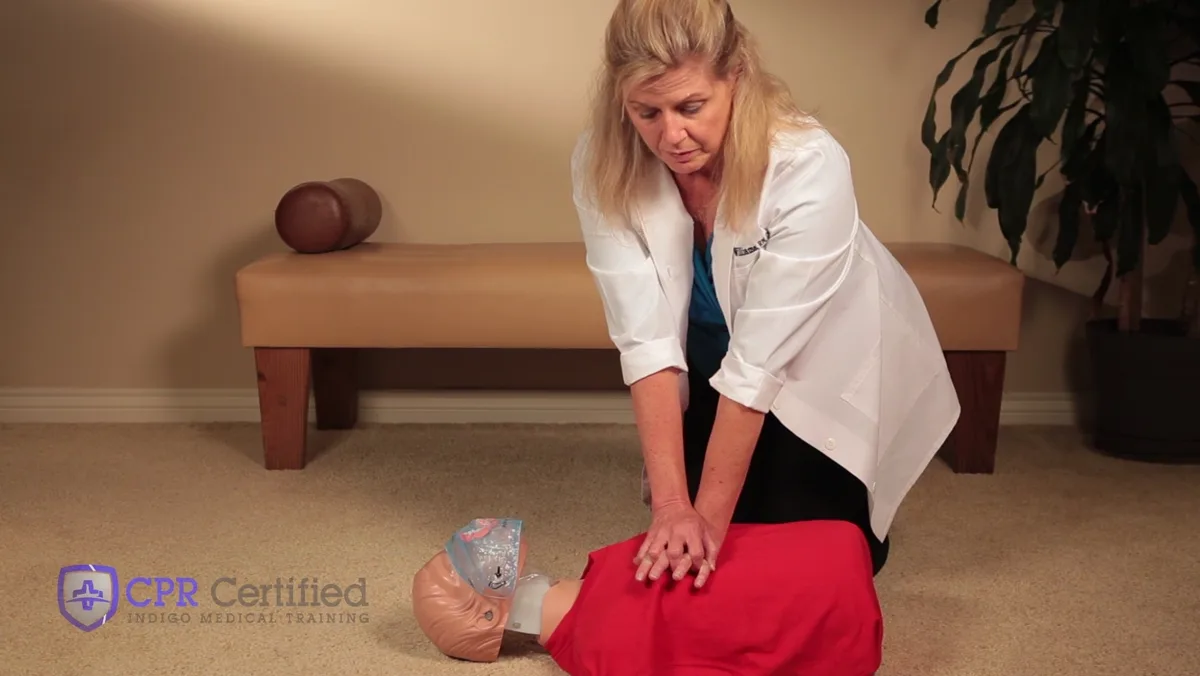
Find the spot by tracing a line across from the armpit to the center of the chest. That lands you on the lower half of the breastbone, which is where you want to be.
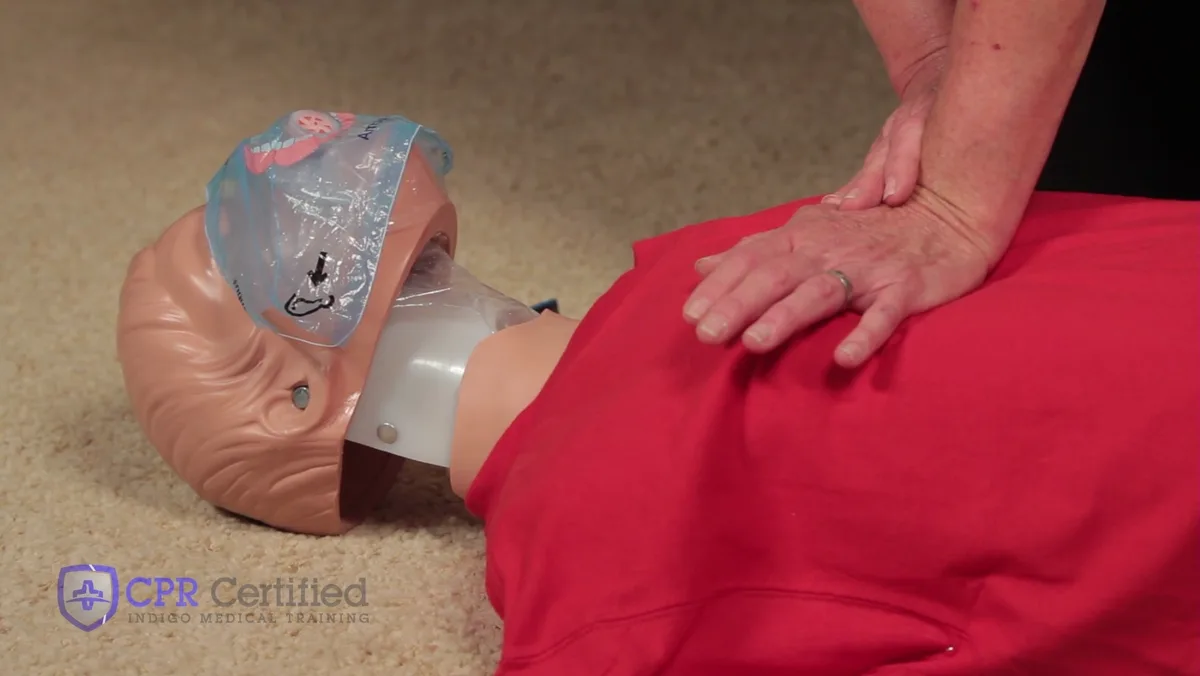
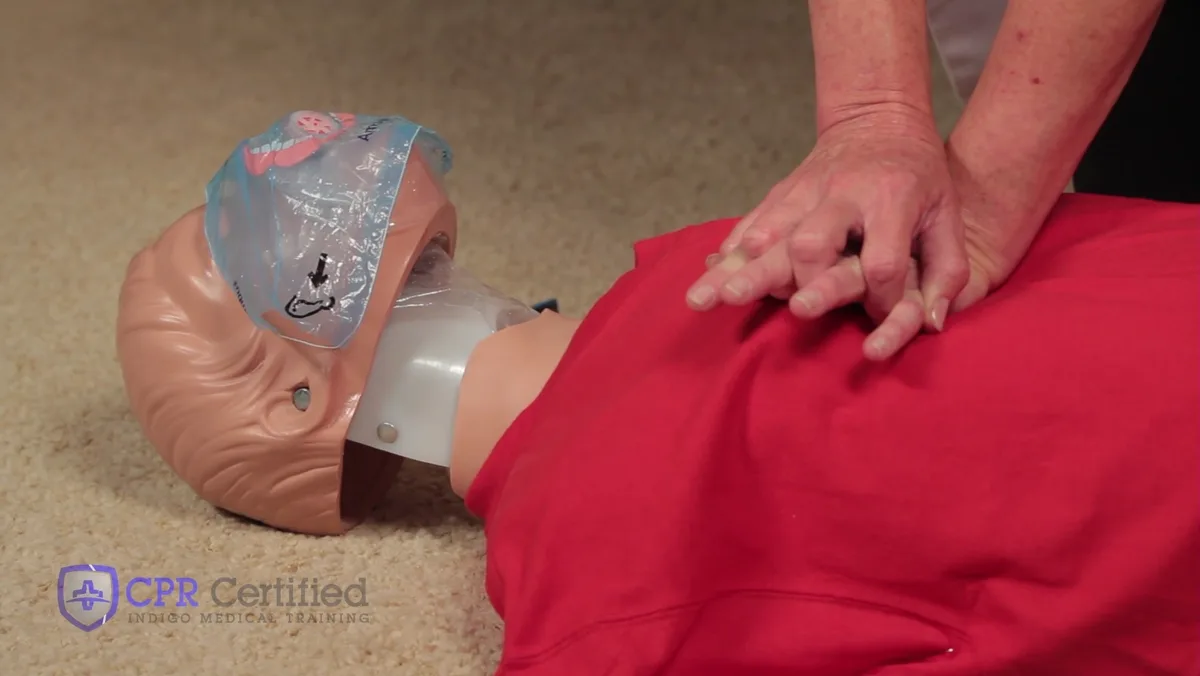
Heel of one hand down on that spot, then your other hand on top, fingers laced together and lifted off the ribs.
Arms straight, shoulders stacked directly over your hands. You're pushing with your body weight, not your arms — arms tire out in about a minute, and this may take several.
Kneel close beside the chest rather than reaching across. Leverage is most of this.
The four numbers that matter
The rate has an upper limit for a reason worth knowing, because it explains the whole set: pushing too fast or too deep is its own problem. The heart has to refill between compressions, and if you never let it, you're moving less blood rather than more. Letting the chest come all the way back up is as important as pushing down — and it's the thing people stop doing first when they get tired.
For the tempo, counting out loud works and so does humming something. "Stayin' Alive" is the famous one and it genuinely sits in the right range. Whatever keeps you honest.
Breaths, and when to skip them
Two breaths after every thirty compressions. Tilt the forehead back, lift the chin, pinch the nose shut, and cover their mouth with yours — or with a barrier device if you've got one. Each breath takes about a second, and you're watching the chest, not counting.
If the chest doesn't rise, reposition the head once and try again. Don't spend a third attempt on it — get back to compressions.
And if you're not going to give breaths, that's a real option rather than a failure. Plenty of people won't put their mouth on a stranger, and hesitating over it costs more than skipping it does. Compression-only CPR is its own approach with its own reasoning, and for an adult who collapses suddenly it works.
When you can stop
Someone takes over — paramedics, or another trained person.
An AED is ready to use. Turn it on and follow it; it will tell you when to resume. It decides whether to shock, not you.
The person starts moving, breathing or responding on their own.
You physically cannot continue. Swap with somebody every couple of minutes if you can — good compressions get worse fast, and most people overestimate how long they can keep going.
Why the order matters
Everything above is arranged around one idea:
- 1 Recognize & respond
- 2 Call 911
- 3 Start CPR
- 4 Defibrillate (AED)
- 5 Advanced care
Recognizing it starts the clock. Calling brings people who can do more than you can. Compressions keep blood moving to the brain while everyone waits. A defibrillator is the thing that can actually restart a heart in the rhythm that causes most of these — and it works best early. Then hospital care, then recovery.
That's why the call happens now instead of after five cycles, and why you send someone for the AED before you need it. You are not just helping — you are holding the line until the part that fixes it can get there.
Put it into practice
Training scenario:
You're in line at a coffee shop on a weekday morning. A man ahead of you sits down heavily on a chair, then slides onto the floor. He's not moving. There are maybe fifteen people in here, two staff behind the counter, and everyone has turned to look. Nobody has moved. Someone says "is he okay?" and someone else says "I think someone's calling."
Walking it through:
The dangerous sentence is "I think someone's calling." Nobody is. Fifteen people each assumed one of the other fourteen had it handled, which is what a crowd reliably does — and it's why the fix is so specific. You don't ask the room. You pick a face, describe them out loud so they know they've been picked, and give them the whole job: call 911, find an AED, come back.
Then the two signs. He's not responding to a shout and a shoulder tap. Watch the chest for five to ten seconds — and if he makes a sound like a snore or a gasp somewhere in there, that is not breathing, and it's the most common reason people wait. You're not checking a pulse. You have what you need.
So: hands on the lower half of the breastbone, shoulders over your hands, and push. Two inches, a hundred to a hundred and twenty a minute, letting the chest come back up each time. Send someone to the door to wave the ambulance in. And when the second person offers to take over — say yes, at about two minutes, before your compressions get shallow without you noticing.
Medically reviewed by Dr. Mary Williams, RN, DC
Video transcript
0:00 In this video, I'm going to demonstrate how to administer CPR on an adult. Okay, suppose you find someone lying
0:09 down on the floor. What are you going to do? First, assess the scene. Look around. Make sure the scene is safe.
0:19 Are there safety hazards, a chemical spill, electrical wires, gas fumes, or anything dangerous? You can't help anyone if you become a
0:29 victim, too. If the scene is safe, check the person for a response. Tap or shake the victim on the shoulder and shout, "Are you okay?" If you do not
0:40 get a response from the victim, yell for help. Next, tell a specific bystander to phone 911 or the emergency response number and
0:50 get an AED. And very importantly, to come back to help. Many facilities, stores, schools, airports, conventions,
0:58 and sports arenas will have AEDs available. Next, check the victim for breathing or only gasping. You need to scan the victim's body back
1:13 and forth from head to abdomen for at least 5 seconds, but no more than 10 seconds. Agonal breathing sounds like gurgling or
1:23 gasping. It is not breathing. You must start CPR. Now, check for a pulse. To locate a carotid pulse on an adult or
1:34 child, place your two fingers on the center of the victim's neck. Slide your fingers down the side of the neck into
1:42 the notch between the muscles. You should feel a strong pulse there. If the victim has a pulse, but is not breathing, give one rescue breath every
1:53 5 seconds. Then, recheck the victim's pulse every 2 minutes. To perform a rescue breath, gently tilt the victim's forehead back with one
2:04 hand, and with your other hand, lift the victim's chin. This position opens the airway. Pinch the nose closed and cover the
2:14 victim's mouth with your mouth, breathing life-giving air into the victim. If you have a one-way mouth guard, use
2:22 it as directed. The mouth guard has a one-way valve and protects the rescuer from contact with vomit, secretions,
2:30 infectious fluids, et cetera. Place the elastic bands around the victim's ears to hold it in position. Give two rescue breaths, 1 second for
2:43 each breath. Look for chest rise. If you don't see the chest rise, reposition if needed. If the victim has no pulse, start the
2:52 CPR cycle of 30 compressions, two breaths, 30 compressions, two breaths until help arrives or you can no longer
3:01 perform effective CPR. Let me show you how to do this. First, if possible, remove clothing out of the way of the victim's chest.
3:13 Next, locate your hand placement for compressions. With your hand, draw a line from armpit to center of chest for placement.
3:23 Place the heel of one hand on the lower half of the sternum or breastbone. Now, place your other hand over the
3:31 first, interlacing your fingers for support. With your arms straight and your shoulders positioned over the victim's
3:39 chest, push down on the victim's chest. For an adult, you will want to push down at least 2 inches or 5 centimeters.
3:49 Now, watch as I perform 30 deep compressions in 18 seconds or less. You want to be able to give at least 100 compressions in a minute.
3:59 You may lift your hands slightly off the chest between compressions to allow for full chest recoil. But, keep your hand placement.
4:08 Keep interruptions to a minimum. It helps to count out loud. Some say humming the tune to the 1980s pop tune Stayin' Alive is good for
4:19 keeping the right tempo. I'll give 30 compressions in 18 seconds or less. Counting out loud to 30. After 30 compressions, give two breaths.
4:45 Look for the chest to rise between breaths. If there was no one available to help, after performing five cycles of CPR,
4:54 call 911 and or get an AED.
A one-page version of this lesson, made for printing. Everything above is the current sequence.
 Download or print this sheet
Check yourself
Three questions on what you just read.