

In this video, we demonstrate the choking rescue for an adult or a child, including back blows, abdominal thrusts, and what to do differently if the person is pregnant or you're by yourself.
What you’ll learn
- Distinguish mild choking from a life-threatening blockage — and recognize why a coughing person must not be touched
- Perform the current five-and-five rescue sequence, updated in the 2025 guidelines
- Adapt the technique for pregnant women, larger adults — and for yourself, alone
- Recognize the moment choking becomes CPR
Choking kills quickly and quietly — a blocked airway gives you only minutes, and the person who most needs help is the one who can no longer ask for it. The encouraging part: the rescue technique is simple, physical, and learnable in the time it takes to read this page. The essential part: knowing when to act, because the most common choking mistake isn’t bad technique — it’s intervening on someone who’s still coughing, or waiting politely on someone who no longer can.
This lesson covers recognition, the current rescue sequence (updated in the October 2025 guidelines — see below, because it changed), the special cases, and the handoff to CPR. Choking babies under age one are a different technique entirely — see How to Save a Choking Infant.
Mild or severe — the difference that decides everything
Mild blockage | Severe blockage | |
|---|---|---|
Can they… | Cough forcefully, speak, breathe | Not cough effectively, not speak — maybe a high whistle or silence |
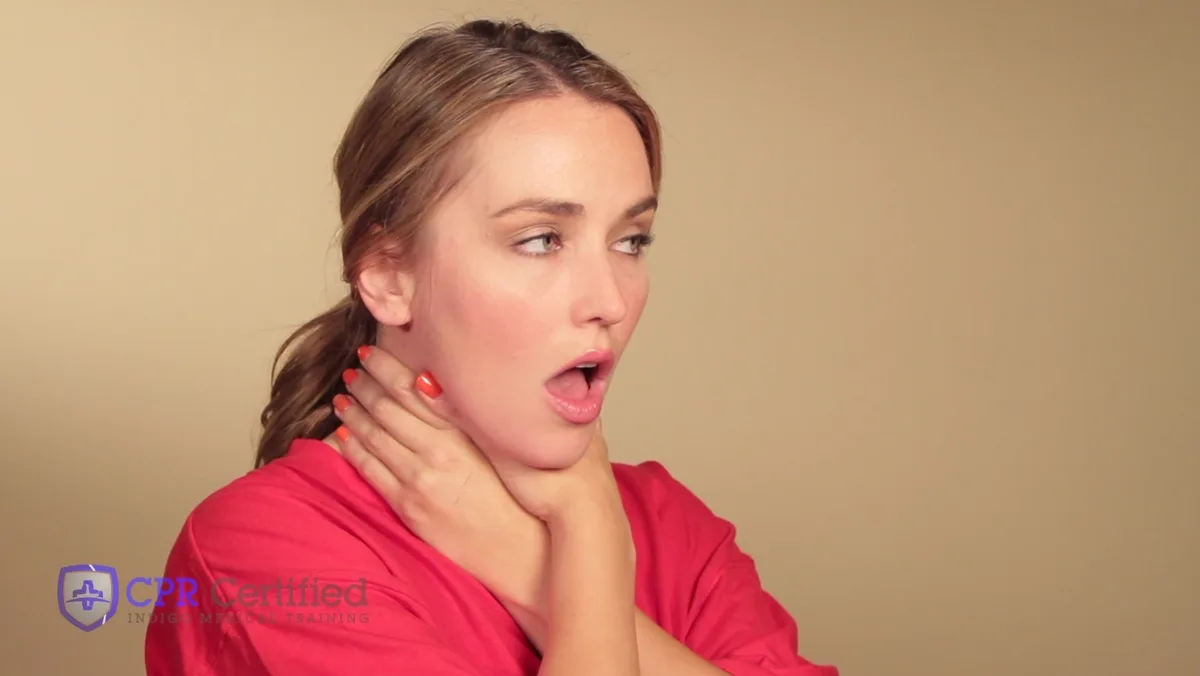
What you’ll see | Distress, but air is moving | The universal choking sign — hands clutching the throat; panic; face reddening then bluing |
What you do | Encourage coughing. Do not thrust, do not slap — their cough beats yours. Stay ready. | Act now — the sequence below, with 911 called |
The universal sign — one or both hands gripping the throat — exists because a person with a blocked airway cannot tell you they’re choking. Ask one question: “Are you choking?” A nod with no voice is your green light.
How to Save a Choking Adult or Child: Step-by-Step
Current sequence per the 2025 AHA Guidelines — alternating back blows and abdominal thrusts.
Confirm severe choking. “Are you choking?” — no voice, ineffective cough, or the universal sign means go.
Get 911 started. Point at a bystander: “You — call 911.” Alone? Call on speaker while you begin — for an adult, don’t leave to call.
Give 5 back blows. Stand to the side and slightly behind. Support their chest with one arm and lean them forward at the waist — so a freed object falls out, not further in. Strike 5 sharp blows between the shoulder blades with the heel of your hand.
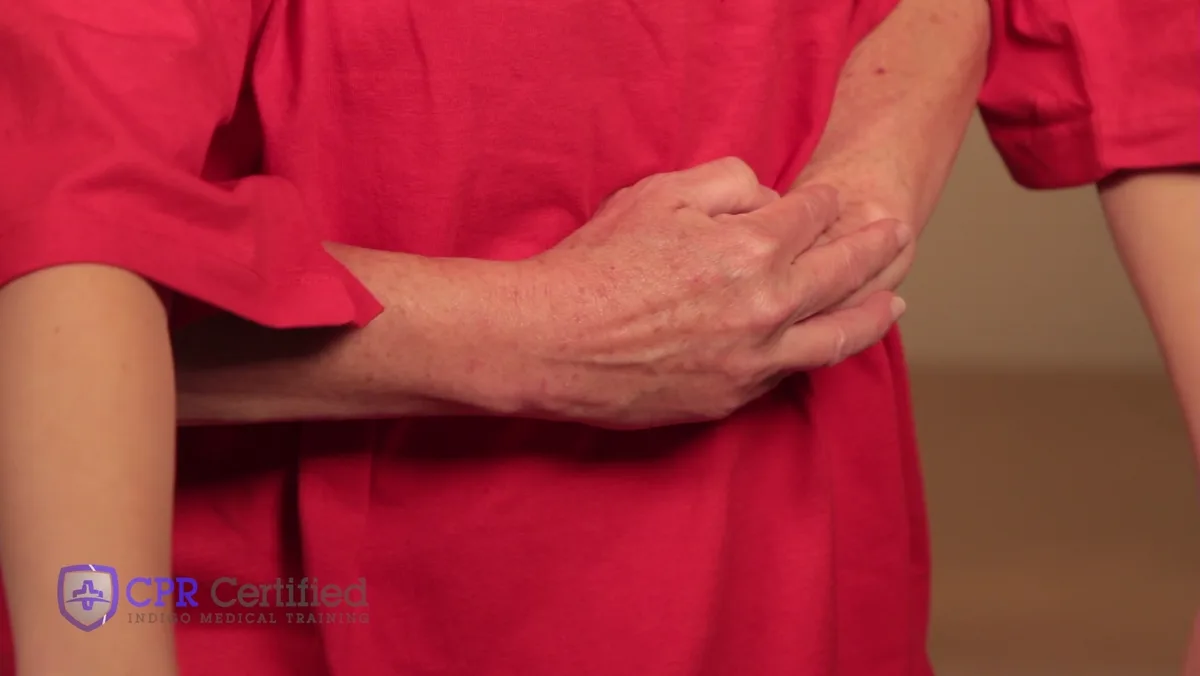
Give 5 abdominal thrusts (the Heimlich maneuver — this is what the video demonstrates). Stand behind them, wrap your arms around the abdomen, make a fist and place it thumb-side in, just above the navel. Grasp the fist with your other hand and drive inward and upward, hard — each thrust is its own attempt to blast the object out.
Alternate — 5 blows, 5 thrusts — until the object flies out, they can cough/speak/breathe, or they stop responding.
If they stop responding: this is now CPR. Lower them to the floor, start chest compressions immediately, and have the AED brought. Between compression sets, look in the mouth — remove an object only if you can see it. The compressions themselves can expel the blockage.
Afterward — even if it all worked: anyone who received abdominal thrusts should be checked by a healthcare provider. Thrusts save lives and can bruise organs doing it; both facts are true.
Special cases
Pregnant women and larger adults: abdominal thrusts don’t fit or aren’t safe — use chest thrusts instead. Arms under the armpits, fist on the center of the breastbone, thrust straight inward. Same rhythm, same alternation with back blows.
Choking alone: call 911 on speaker, then give yourself abdominal thrusts — your fist above your navel, drive it inward-upward, or better: press your upper abdomen sharply over the back of a chair and let the furniture do the thrusting. Repeat hard until it clears.
A child (age 1 to puberty): same sequence, scaled down — kneel behind them instead of standing, and moderate the force to the body in front of you. Under age 1 is a different technique entirely: never abdominal thrusts on an infant — see How to Save a Choking Infant.
Unconscious choking — went down, or found down
Two versions of the same emergency:
They stop responding during your rescue. The sequence has already told you what happens: lower them to the floor, start chest compressions immediately, send for the AED, and between compression sets look in the mouth — remove an object only if you can see it. Compressions do double duty here: they circulate blood and they’re the force most likely to expel the blockage.
You find someone already unconscious. You may have no idea it’s choking — and that’s fine, because the response is the same as any unresponsive person: check for normal breathing, call 911, start CPR. If the airway is blocked, the look-before-breaths habit will find the object (a bite of food at a dinner table, a small toy near a child), and the compressions work on it exactly as above. This is precisely why the choking lesson and CPR training are one skill set, not two — every severe choking that isn’t resolved standing up becomes CPR on the floor.
What people get wrong
The back-blow fear deserves a word too: generations were taught that slapping a choking person’s back “drives the object deeper.” That worry applied to slapping someone standing upright — with the person leaning forward, gravity and the blow work together, which is exactly why current guidelines put positioned back blows first in the sequence.
Put it into practice
Training scenario:
At a steakhouse birthday dinner, your uncle goes quiet mid-conversation. He half-stands, both hands at his throat, eyes wide. Your cousin thumps him once on the back where he stands; your aunt pushes a water glass toward him. He can’t answer when she asks if he’s okay.
Walking it through: the hands at the throat plus no voice is severe choking confirmed — the water is out (it can’t pass a blocked airway) and the upright thump was well-meant but unpositioned. Point at your cousin: “Call 911.” Get beside your uncle, support his chest, lean him forward, and give 5 hard back blows between the shoulder blades — then move behind him, fist above the navel, 5 inward-upward abdominal thrusts — and keep alternating. The moment he coughs the bite out and gasps, the emergency ends but the episode doesn’t: he got abdominal thrusts, so he gets checked out tonight. And if he’d gone limp instead — floor, compressions, AED, without hesitation.
Medically reviewed by Dr. Mary Williams, RN, DC
Video transcript 1:29
0:00 In this video, I'm going to demonstrate how to save a choking adult or child whether conscious or unconscious. When a person chokes on
0:09 something this blocks the airway. If mild, the person can cough and cough out the obstruction and resume breathing. If severe, the person may use
0:21 the universal sign for choking which is grabbing the throat with one or both hands indicating they cannot breathe or
0:32 speak. The Heimlich maneuver is a technique you can use to help this adult or child choking victim. Stand behind the
0:41 victim, wrap your arms around their abdomen make a fist with one hand and place it slightly above their belly button or
0:49 umbilicus place your other hand over your fist. Make a thrusting motion with your fist or hand upward and back
0:58 continue giving thrust until the object is dislodged or the person stops responding if the person stops responding, lay them down and start CPR
1:07 immediately and call for help and an AED. For a very large person or pregnant woman you may place your arms under
1:16 their armpits and thrust over the breast- bone instead of the abdomen. Any person who has received thrusts should follow up with their
1:26 health care provider.
Check yourself
Three questions on what you just read.