

In this video, we walk you through the protective equipment used around blood and body fluids, and how to decide what a situation calls for.
What you’ll learn
- Choose protection by what could reach you instead of by habit
- Recognize when gloves alone have stopped being enough
- Tell the difference between eye protection and ordinary glasses
- Know what your employer must supply, and what to do about a latex allergy
- Understand why taking it off is the dangerous half
There's a particular moment this lesson is about. You've got gloves on, you've started, and then you see how much there is — or the person moves, or something drips where you weren't expecting it — and a thought comes to mind that you can't just brush off: gloves weren't the right answer to this.
By then your options have narrowed. The useful skill isn't knowing what the equipment is called. It's reading a situation before you're in the middle of it, and being wrong in the safe direction.
The question that picks your kit
Most guidance answers this by task: here's what to wear for this job, here's what to wear for that one. That works right up until you come across a situation you didn't anticipate — and that tends to be most situations that need PPE.
There's a better question underneath the list, and it's just one question: what could reach me, how much of it, and how fast?
Contact — could it get on my hands? That's gloves, and the answer is almost always yes.
Volume — could enough of it soak through what I'm wearing? That's a gown or an apron.
Speed — could any of it move fast enough to reach my face? Splashing, spraying, a cough, a container opened under pressure. That's eye protection, and often a face shield.
Answer those three and the equipment picks itself, including for situations nobody wrote a rule about. The name for all of it together is personal protective equipment — PPE on any form you'll be asked to sign — and it's worth knowing the term mostly so you can ask for the right thing.
Matching protection to the situation
Situation | Gloves | Gown or apron | Eye or face |
|---|---|---|---|
Touching a small wound, dressing already in place | Yes | No | No |
Cleaning a small spill on a hard floor | Yes | If kneeling in it | If splashing is likely |
Heavy or continued bleeding | Yes | Yes | Yes |
Anything under pressure, or coughing at close range | Yes | Yes | Face shield, not just goggles |
Handling waste bags or containers | Yes — heavier duty | If carrying against your body | If the bag is overfull |
Laundry or textiles soaked with blood | Yes | Yes | If shaking or sorting |
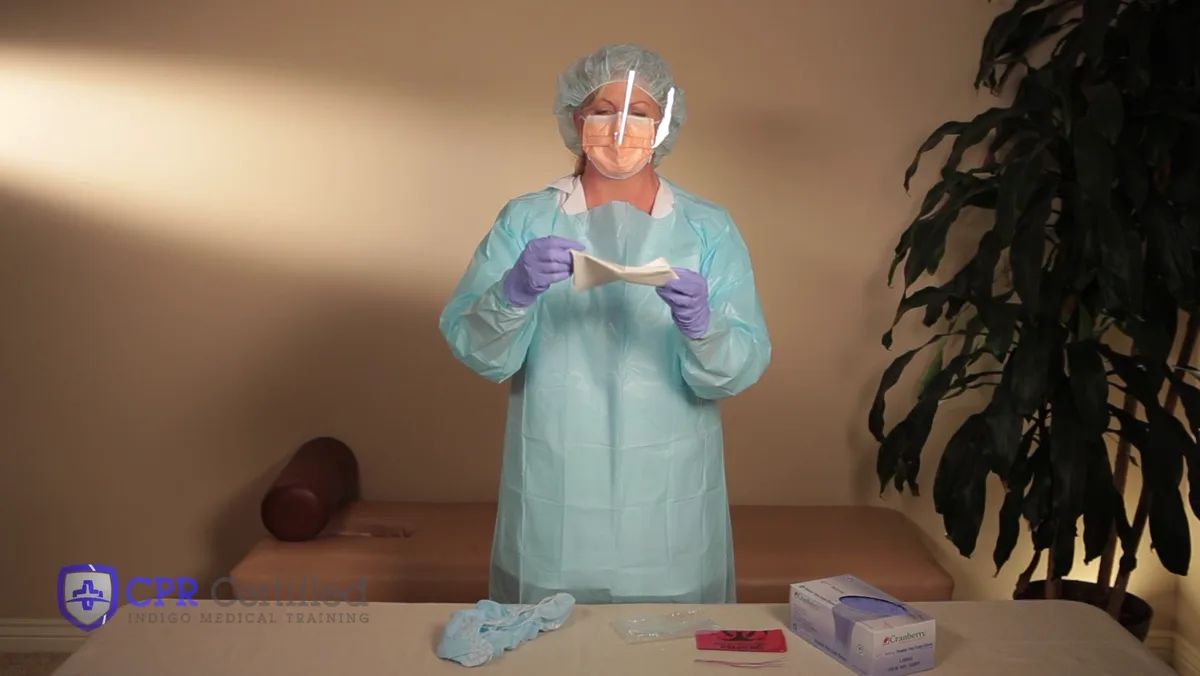
The table is a starting point, not a permission slip. If your read of the situation says more, wear more — nobody has ever been harmed by a gown they turned out not to need.
Gloves: fit, limits and single use
Gloves are the piece everybody has and the piece most often used wrong, mostly because they feel like more protection than they are.
Fit is a safety issue. Too big and they catch and tear; too small and they split at the thumb. A glove that doesn't fit is only doing part of the job.
Single-use means single-use. Not washed, not sanitized, not taken off and put back on later. Alcohol breaks down the material, and a glove that's been washed is a glove of unknown strength.
Change them at the boundaries — between people, between tasks, and right away if they tear or get contaminated.
A latex allergy is your employer’s problem to solve, not yours to work around. Hypoallergenic gloves, glove liners, powderless gloves or a similar alternative have to be readily accessible to you — a requirement, not a favor.
And gloves have an ending, which is where most of their risk actually lives. The outside of a used glove is contaminated by definition, so how they come off decides where that contamination goes. That's a short lesson of its own and worth the two minutes.
Your glasses are not eye protection
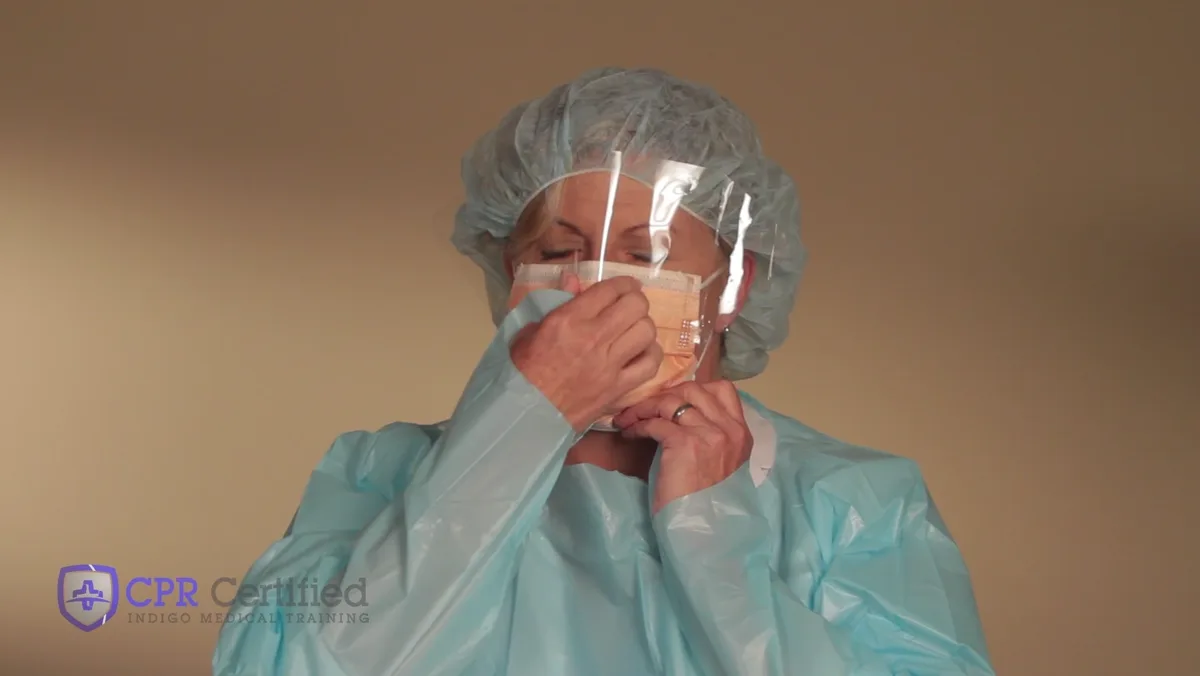
This surprises people who have been quietly relying on them for years, and the reason is specific. What counts as eye protection here is glasses or goggles with solid side shields, or a chin-length face shield — and most glasses don't have proper side protection. They were built to hold lenses in front of your eyes, not to close the gap beside them, and splash doesn't politely arrive from straight ahead.
Safety glasses — impact protection with solid side shields, which is the part that matters. Better than nothing, still open at the top.
Goggles — sealed around the eyes. The right answer when splashing is the concern, and they fit over prescription glasses.
Face shield — covers eyes, nose and mouth. The answer when anything might spray, and the one people skip because it feels like overkill.
Gowns, aprons and sleeves
The thing that matters is fluid resistance, not thickness or how it looks. A cloth lab coat soaks it up; it doesn't protect you. Once fluid is through the fabric it's against your skin, and the coat is holding it there.
Cover where the work actually happens. Forearms are the most exposed and least protected part of you — short sleeves plus a body-only apron leaves the part that reaches into things completely uncovered.
Paid for, provided, replaced
That last one is the practical test. Equipment sitting in a locked cabinet on another floor is equipment that won't get worn at four in the afternoon by someone who's already behind. If the right protection isn't within reach of the work, that's a gap worth pointing out — and the obligations behind it are broader than most people realize.
Taking it off is the dangerous half
Putting protection on is easy, because everything is clean. Taking it off is where people contaminate themselves, because by then the outside surfaces are the problem — and those are the surfaces your hands naturally reach for.
The rule is the same for every item: the outside is contaminated, so touch only the inside. Take the most contaminated items off first, do it away from other people and clean surfaces, and wash your hands afterward even though you were wearing gloves the whole time. Gloves have a technique of their own, and it's worth learning properly.
Put it into practice
Training scenario:
You are a custodian at a middle school. A student had a nosebleed in a hallway and went to the school nurse; you've been asked to help clean up the mess. You put gloves on, grab some shop towels, and get down to it. Then you notice: it isn't the few drops you were told about. There's a run of it down a locker front, a puddle at the baseboard, and spatter at about knee height where somebody already walked through it and didn't notice.
Walking it through:
The three details are the puddle (volume — you're kneeling in it, so a gown or apron), the spatter on the locker (it has already traveled, and cleaning a vertical surface throws things back toward your face, so eye protection), and the footprints — somebody walked through, which means the area is bigger than what you can see and other people are still using this hallway.
The tempting wrong move is to push on anyway, because you're already down there, you're already gloved, and going to get the right gear means starting over. That's the whole reason this lesson is organized around reading a situation before you commit to it — the moment you're kneeling in it, the cost of doing the right thing has gone up, and it'll go up again in another five minutes.
So: stop, block off the hallway before anyone else spreads it further, and come back with an apron and eye protection. What you do next — the order of cleaning, what to use, and where the used paper towels go — is a procedure worth knowing before you need it.
Medically reviewed by Dr. Mary Williams, RN, DC
Video transcript
0:00 in this video I'm going to discuss blood-borne pathogens and personal protection equipment whether in the home
0:08 workplace or community it's important to know how to handle the risks associated with exposure to blood-borne pathogens
0:17 the United States Centers for Disease Control or CDC recommends all healthcare and food service workers follow
0:26 universal precautions precautions to protect against exposure must be taken when there is any potential for exposure
0:34 to bodily fluids it is assumed that all bodily fluids have the potential to transmit disease the universal precaution is treat all human blood
0:46 bodily fluids and other potentially infectious materials as if they are infectious universal precautions include
0:54 the use of personal protective equipment commonly called PPE so now I'll show you some examples shoe covers to cover your
1:04 shoes a gown to cover your clothes a hairnet a safety mask and face shield gloves an absorbable pad for wiping up spills a
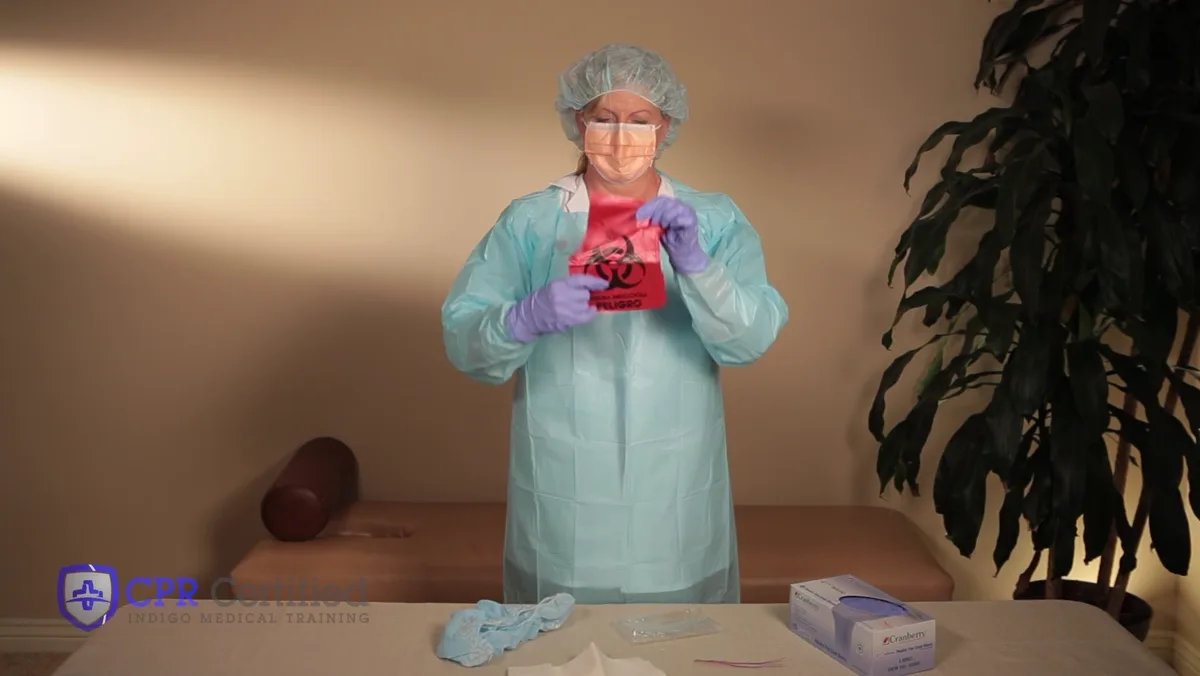
1:23 red biohazard bag for waste and the red twist ties to tie the bag shut always wear PPE when cleaning up spills that
1:34 are potential sources of pathogens
Check yourself
Three questions on what you just read.