

In this video, we demonstrate how to take contaminated gloves off without letting your bare skin touch the outside of them.
What you’ll learn
- Take gloves off without transferring anything to your hands
- Apply the one rule the whole technique is built on
- Recognize the four seconds where most contamination actually happens
- Avoid the common mistakes, including the one that looks careful
- Know what to do if something does reach your skin
You can do everything right for twenty minutes and undo it in about four seconds. That's the whole reason this has a technique rather than just being something you do at the end.
The unhelpful part is that when it goes wrong, nothing happens. Nothing tears, nothing splashes, nothing feels different. You take the gloves off, drop them in a trash can, and carry on — and the only sign that anything went wrong is that there isn’t one.
The one rule underneath the technique
Everything below is that rule turned into hand movements. If you remember the rule and forget the steps you'll improvise something workable; if you remember the steps and forget the rule you'll eventually do them in a situation they weren't shaped for.
There's a second rule sitting underneath that one, and it isn't advice — it's a requirement in the regulations that cover this work: hands get washed immediately, or as soon as feasible, after gloves come off. Every time, whether or not anything looked wrong. That rule was written because gloves that came off intact aren't evidence of anything, which is the whole difficulty this lesson is about.
How to remove gloves safely: step-by-step
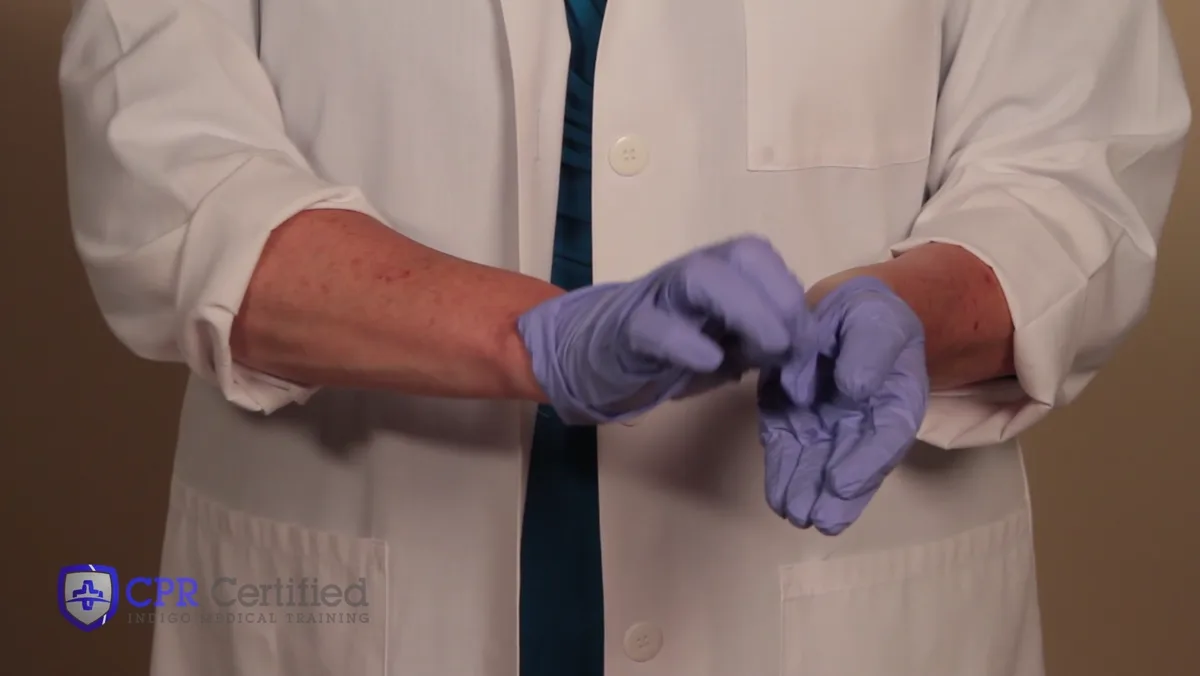
Pinch the outside of one glove near the wrist or the base of the palm. Gloved fingers on glove — this is the hand that's allowed to touch the outside.
Peel it off, turning it inside out as it comes. Do not snap it or let it flick.
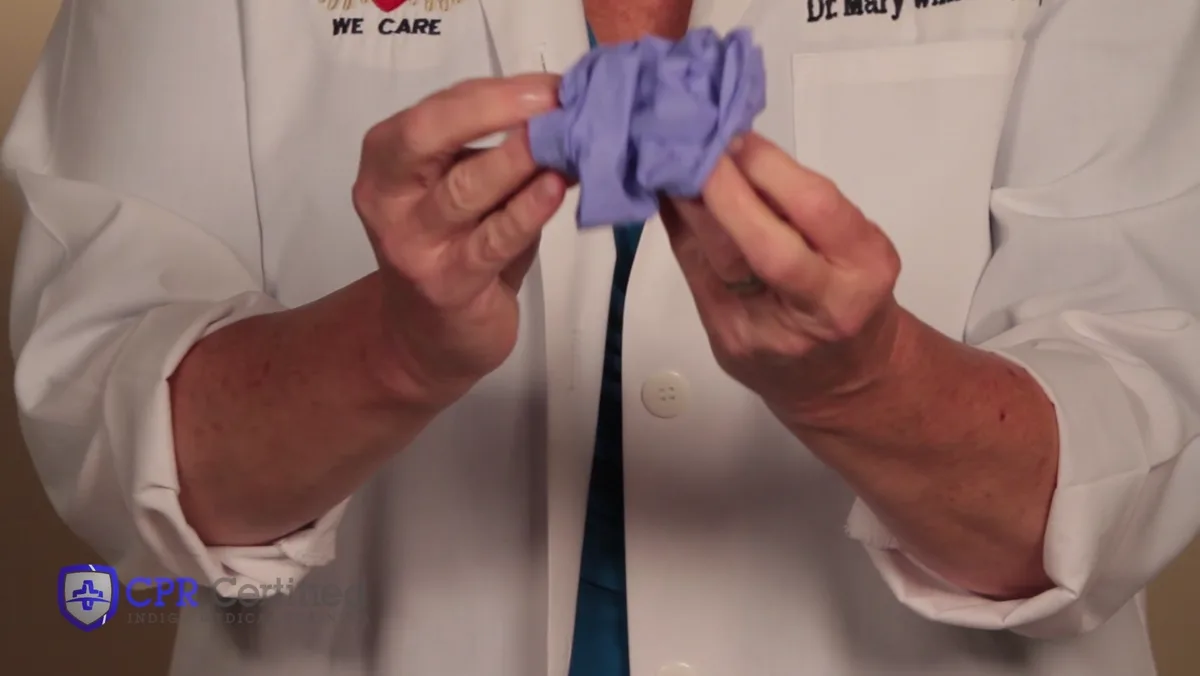
Ball it up in your still-gloved hand and hold it there. You end up with a neat little package — everything contaminated sealed on the inside.
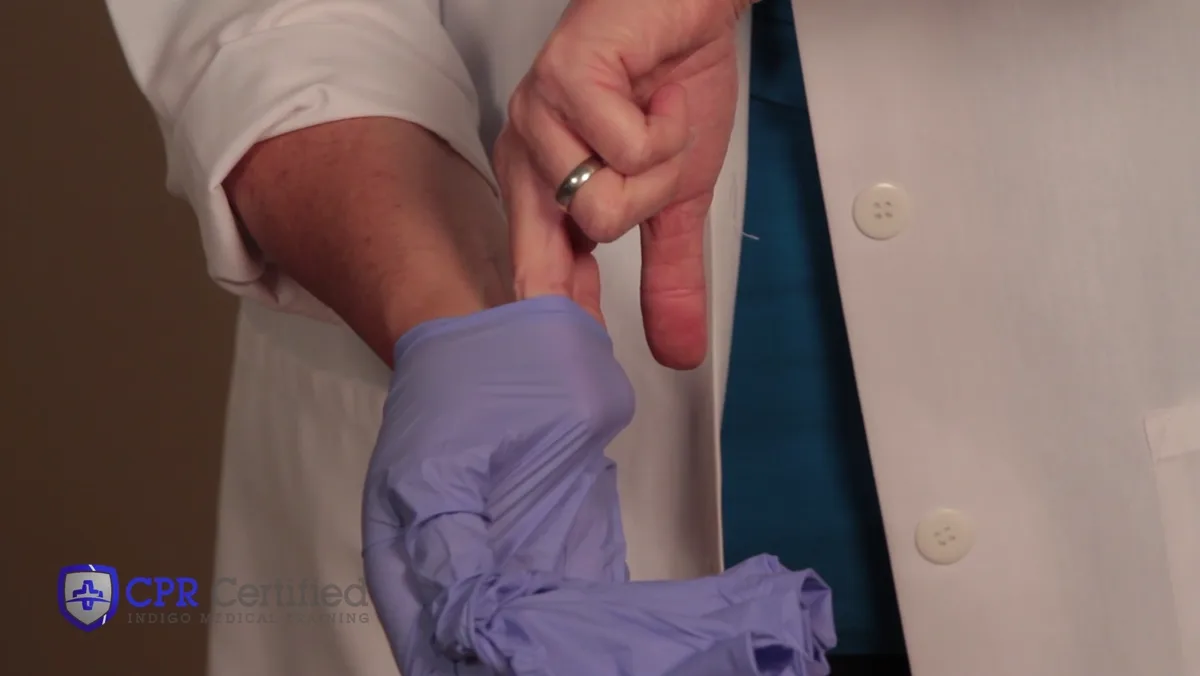
Slide a bare finger under the cuff of the remaining glove, against your own skin. Bare fingers touch only your own wrist and the glove’s inner surface.
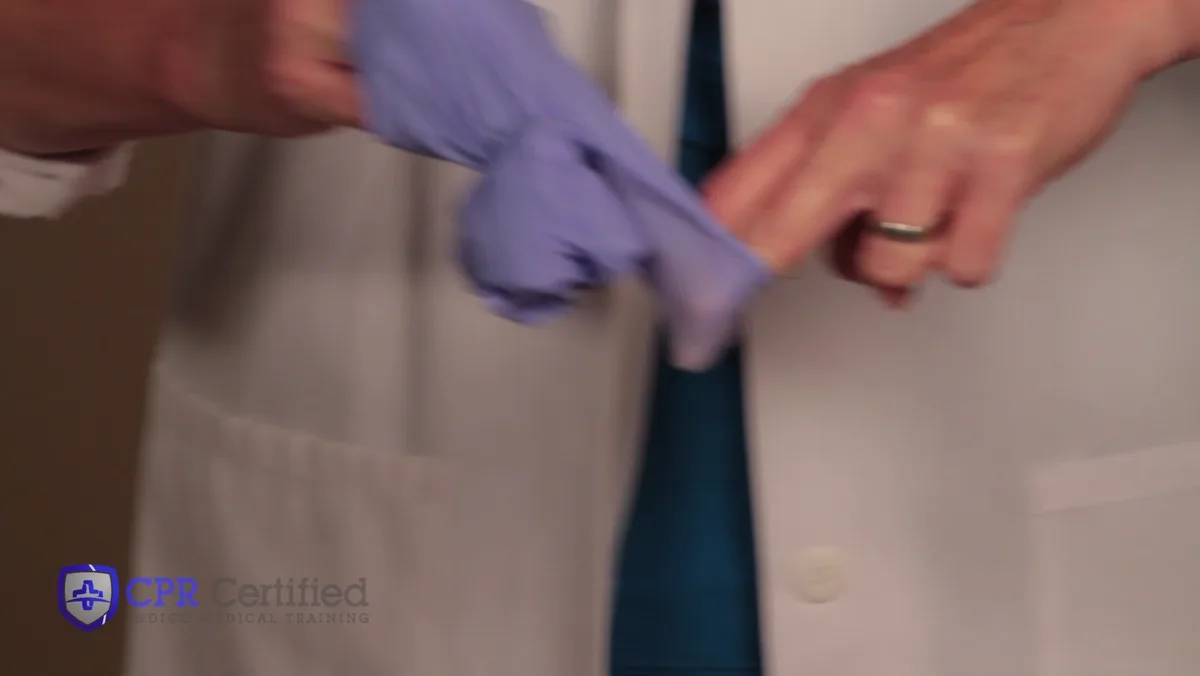
Peel that glove off over the first one, so the balled glove ends up inside it and both are inside out.
Drop them straight into the right container — not onto a surface “for a second”.
Wash your hands. This is part of the procedure. It is not something that happens afterward.
The last step is the one that gets treated as optional and isn't. Soap and running water is the right choice after any blood contact, and gloves count as contact — they fail in ways too small to see.
The mistakes that leave no trace
Almost all of it's one of five things, and the first is by far the most common.
Grabbing the second glove from the outside with a bare hand. It feels natural because that's how you take off any other glove in your life.
Snapping them off. It's satisfying and it flicks whatever is on them into the air and onto you.
Putting them down instead of in. A pair of used gloves on a worktop has just contaminated the worktop, and somebody will lean on it.
Touching something before washing — a door handle, a phone, your face. If your hands did pick something up, this is the step that spreads it.
Rinsing them to get another use. They're single-use, and a washed glove is a glove of unknown strength — the material matters.
There's one more, and it isn't carelessness — it's a reasonable inference from the evidence available. If the gloves came off intact, it looks like nothing got through.
Nothing about the removal gives you feedback, which is why that inference is so easy to make. Gloves develop small failures that are invisible while you wear them, and the far more common route is simpler than a tear: a bare fingertip brushing the outside of the second glove on the way past. It leaves no mark and no sensation. So the wash isn't a precaution against a tear you noticed — it's the step that covers the contact you'd never have detected, which is exactly why the rule requires it every time rather than when something looks wrong.
When something gets through
If you know or suspect that blood reached your skin — through a tear, a splash, or a slip during removal — that's a different situation and it's time-sensitive. Wash it, don't squeeze it, and follow the exposure steps rather than waiting to see whether you feel unwell. Where the gloves themselves go, and what makes waste regulated, is covered separately.
Put it into practice
Training scenario:
You work in a nursing home. A resident has caught his arm on a chair and you've cleaned and dressed it — gloves on throughout, everything done properly, no drama. You step out into the hallway, pull the first glove off neatly, ball it in your hand, and then your phone starts buzzing in your top pocket. You pull the second glove off by the fingertips with your bare hand, drop both in the trash can by the door, and answer it.
Walking it through:
The first error is the one the technique exists to prevent: pulling the second glove off by the fingertips with a bare hand means bare skin touched the most contaminated part of the glove. It's the natural way to take off any glove, which is why it takes deliberate practice to do it the other way.
The second is the phone, and it's really the missing step: you never washed your hands. So whatever came off that glove is now on your fingers, on your phone, and on your face when you hold it to your ear — and your phone will go back in your pocket, come out at lunch, and be handled again by hands you've since washed.
Nothing about the last thirty seconds felt like a mistake, and if you asked yourself afterward whether the dressing had gone well you'd say yes. That's the honest difficulty here. The technique isn't hard and the steps aren't many — the hard part is that it has to survive an interruption, and interruptions are the normal condition of the job.
Medically reviewed by Dr. Mary Williams, RN, DC
Video transcript
0:00 in this video I'm going to demonstrate how to remove your gloves safely if you have gloves available use them as part
0:09 of your universal precautions PPE or personal protective equipment always consider the risk of body fluids blood saliva Etc as
0:21 potential sources of bloodborne pathogens to remove gloves safely start by pinching the outside of the glove close to the cuff and pull downward
0:34 removing the glove from your hand with the now bare hand slip an ungloved finger inside the cuff on the skin side and pull
0:46 downward peel the second glove off over the bundled up first glove be sure to keep skin to skin not touching the
0:55 exposed outside of the glove which may be contaminated if the gloves are contam minated with blood or body fluids use a
1:02 red biohazard bag for disposal if this is not available place them in a plastic bag tie it closed and dispose of
1:14 later if there is a possibility of a criminal act save all items as potential evidence
Check yourself
Three questions on what you just read.